
# Hide the TV Wires in a Rental Without Opening the Wall
To hide TV wires in a rental, pick one of three paths: drop the cables behind a console in a fabric sleeve, run a paintable adhesive raceway from the screen to the outlet, or let a deep console swallow the power strip. Keep the mains on the wall surface. Do not cut plaster or fish a cord through the cavity.
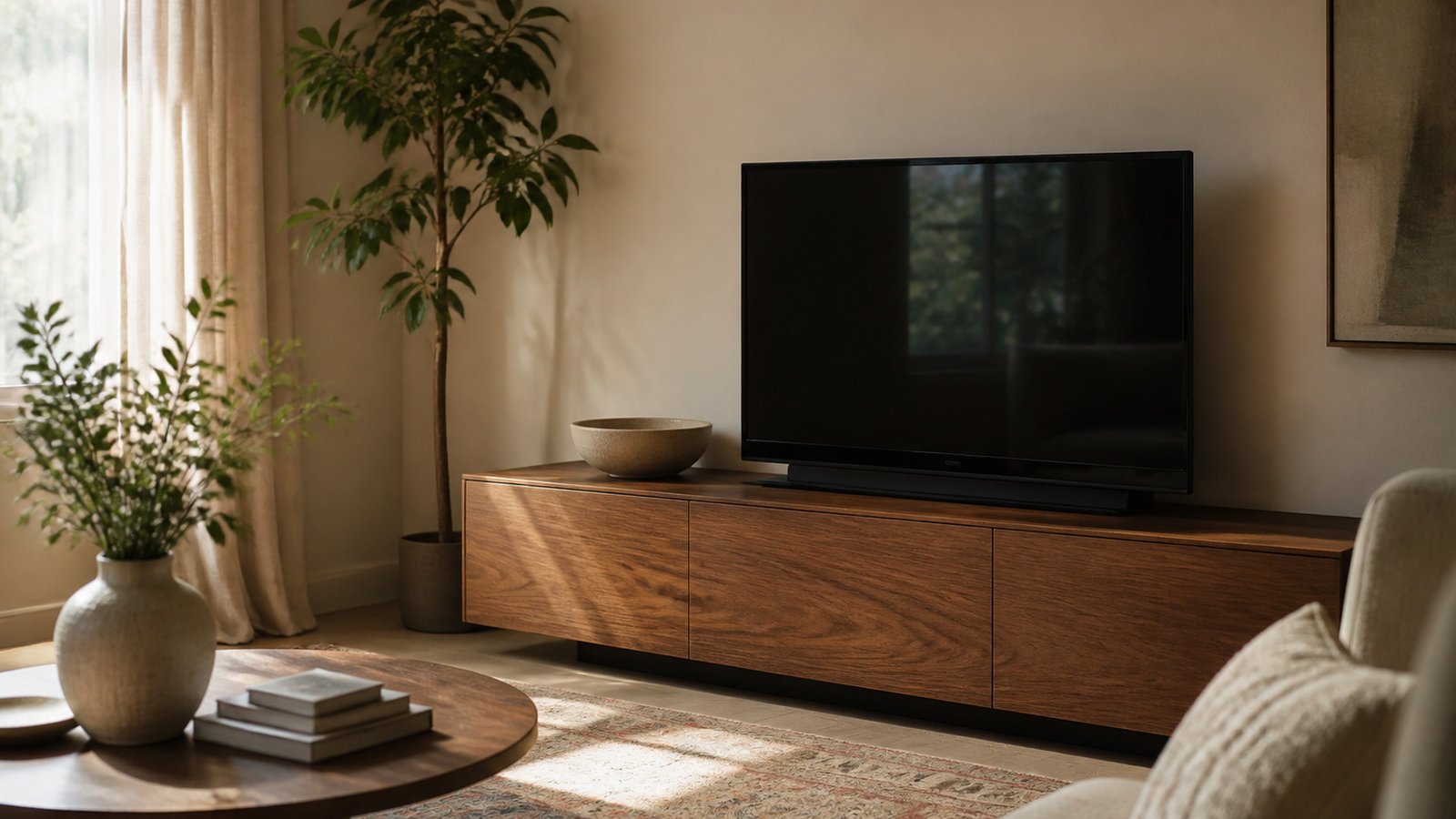
Key takeaways
- Three renter paths only: furniture drop + fabric sleeve, paintable adhesive raceway, or a console that swallows the strip.
- Keep mains on the surface. Do not cut drywall, fish a power cord, or use an in-wall power kit.
- Center the drop on the TV so it reads as part of the object, not a stray on the paint.
- Path 1 is fastest under the screen. Path 2 handles a long or offset run. Path 3 hides bricks and the strip.
- Protect rental paint: test adhesive, mask with painter’s tape, remove cleanly at move-out.
Why do visible TV wires flatten a calm room?
A wall-mounted TV is the largest dark rectangle in a small living room. A power cord, HDMI lead, and soundbar cable hanging in a loose S turn that rectangle into equipment. The eye follows the drop to the outlet, then the brick, then a strip facing the sofa.
Hiding the wires does not make the TV disappear. It lets the screen sit in the same family as the window: one quiet vertical, finished at the edges. That is why you hang curtains high and wide instead of clipping panels to the trim. A sleeve, a painted raceway, or a closed console finishes the media wall.
You need the drop short, centered, and the same color as the wall or the chassis — and the strip off the floor.
Which of the three renter paths should you pick?
Choose by outlet location and console depth. All three keep power in the room. None open the wall.
| Path | Use it when | Wall contact | What it hides |
|---|---|---|---|
| 1. Furniture drop + fabric sleeve | Console under the TV; outlet behind or beside it | None, or one clip under the chassis | Vertical bundle, screen to cabinet |
| 2. Paintable adhesive raceway | Drop over 18 in (46 cm), or outlet 6 in (15 cm)+ off center | Surface channel, painted to match | The run across paint, including an L |
| 3. Console that swallows the strip | Interior 14–16 in (36–41 cm) deep, open back or top grommet | None on the wall | Strip, bricks, HDMI nest |
If two apply, stack them. The usual rental finish is 1 + 3: a short sleeved drop into a cabinet that holds the strip. Use path 2 when there is no cabinet under the TV, or the outlet is on a return wall. A TV already on a stand is path 3. Path 2 hides the vertical; pair it with 3, or the strip stays on the floor.
What measurements do you actually need?
Take six numbers before you buy a sleeve or a kit. Write them on tape stuck to the console.
| Measurement | How to take it | Target |
|---|---|---|
| Bottom of TV to top of console | Floor to chassis underside, minus console height | 4–12 in (10–30 cm) easy drop; over 18 in (46 cm) favors a raceway |
| TV centerline to outlet | Horizontal offset | 0–4 in (0–10 cm) sleeve; 6 in (15 cm)+ elbow or shift the cabinet |
| Outlet height | Floor to receptacle center | Typical 12–18 in (30–46 cm); raceway stops 1–2 in (2.5–5 cm) above the plate |
| Console interior depth | Inside back to inside door | 14–16 in (36–41 cm) swallows a strip and two bricks; under 11 in (28 cm) will not |
| Cable count | Power + HDMI + soundbar + streaming | Bundle under 1.25 in (3.2 cm) |
| Slack at the chassis | Extra length under the TV | 2–3 in (5–8 cm) |
Worked example — 55 in (140 cm) TV. Bottom of TV 36 in (91 cm) from the floor. Console 18 in (46 cm) high, 16 in (41 cm) deep. Outlet 14 in (36 cm) AFF, 6 in (15 cm) left of center. Gap: 18 in (46 cm). Offset: 6 in (15 cm) — a straight sleeve will show a diagonal. Shift the console so the outlet falls behind it, then sleeve into a grommet; or run a painted raceway 18 in down and 6 in across. Buy a 36 in (91 cm) kit.
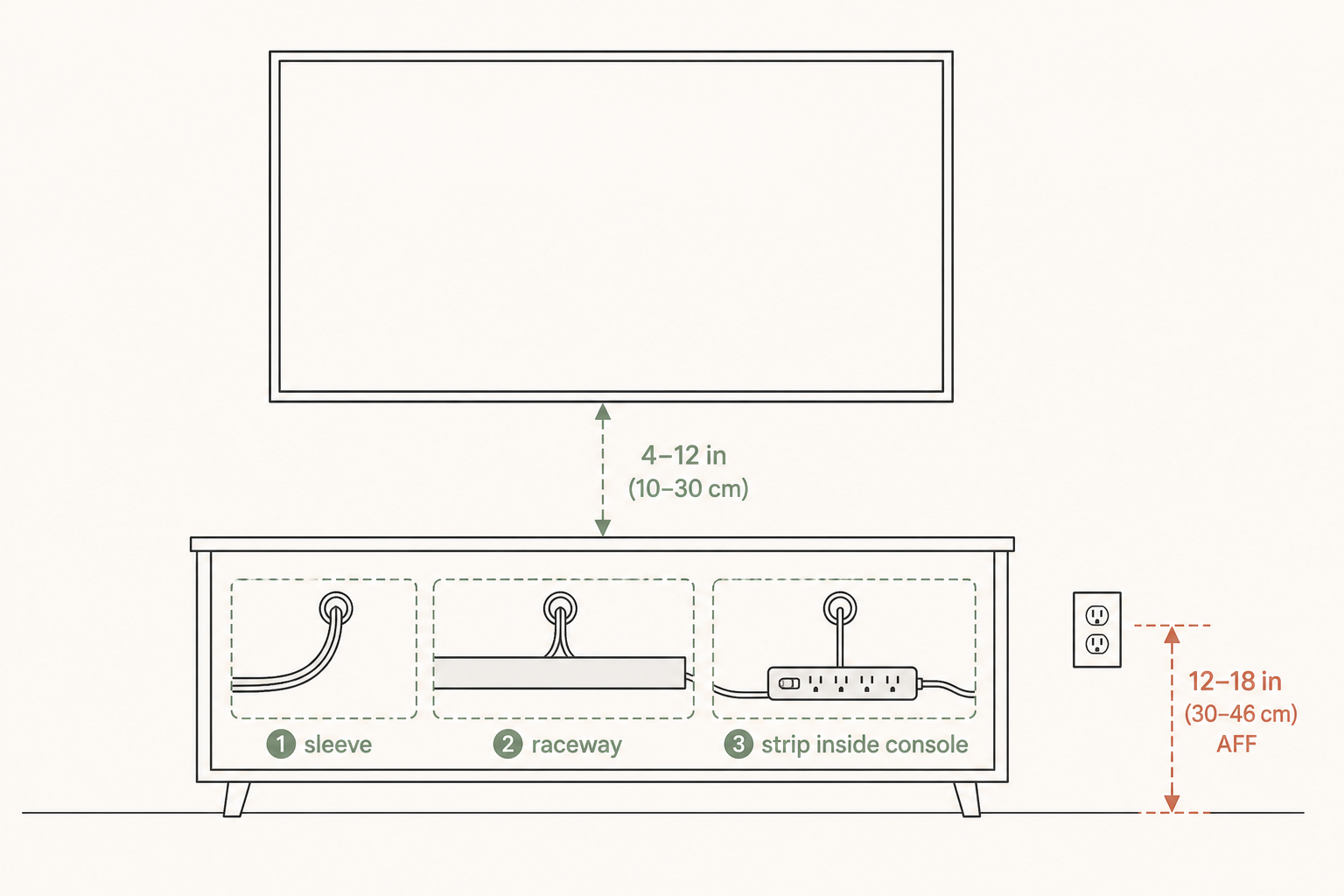
How do you hide TV wires with a furniture drop and a fabric sleeve?
This is the default when the cabinet sits under the screen. The wall stays untouched.
- Edit the cable count. A streaming stick in the HDMI port removes a box. Put the soundbar on the cabinet, not the wall.
- Park the bricks before you wrap. TV, soundbar, and console bricks belong on an interior shelf, or on the floor inside the cabinet’s footprint — not in the sleeve.
- Clip under the chassis, not on the paint. Gather cables in the 1–2 in (2.5–5 cm) gap behind the TV. Use the mount’s channel, or one adhesive clip rated 1–2 lb (0.5–0.9 kg) on the underside of the TV or mount — never on the rental wall. Leave 2–3 in (5–8 cm) of slack.
- Sleeve from that clip to below the console top. Fabric or neoprene, 1–1.5 in (2.5–4 cm) diameter, wall color or charcoal. Cut it so the sleeve disappears into the gap by 2–3 in (5–8 cm).
- Drop into the cabinet, not onto the floor. Land on an interior shelf or through a top grommet. Pair with path 3 so the strip is not in the dust.
One bundle, one color, on the TV centerline.
How do you hide TV wires with a paintable adhesive raceway?
Use a raceway when the drop is long, the outlet is offset, or there is no cabinet to fall into. Painted with the wall, it should read as trim, not a product.
- Confirm the lease and the paint. Adhesive lifts weak latex — paint less than 30 days old, or a dusty flat. Test a 2 in (5 cm) scrap of the raceway tape behind the future console for 24 hours. If the film skins off, skip to path 1 or 3.
- Map the run, then mask it. From 1–2 in (2.5–5 cm) below the chassis, draw a plumb line to 1–2 in (2.5–5 cm) above the outlet plate. Offset with a manufactured elbow. Center the vertical on the TV; step sideways at the bottom, near the console. Mask both sides with painter’s tape.
- Paint the channel off the wall. Two thin coats of the wall color, including the cap. Let it dry. Painting after install marks rental paint.
- Install on a clean, dry wall. Press the base from the top down so the first inch hides under the TV. Do not stretch the adhesive. Feed cords with the TV unplugged. Snap the cap. Stop above the plate.
- At move-out, pull slowly. Warm with a hair dryer on low, lift a corner, and work dental floss or fishing line behind the tape. Pull along the wall, not out from it.
Buy the narrower channel — 0.75–1.5 in (2–4 cm) — if two or three slim cables fit. Listed indoor raceway only.
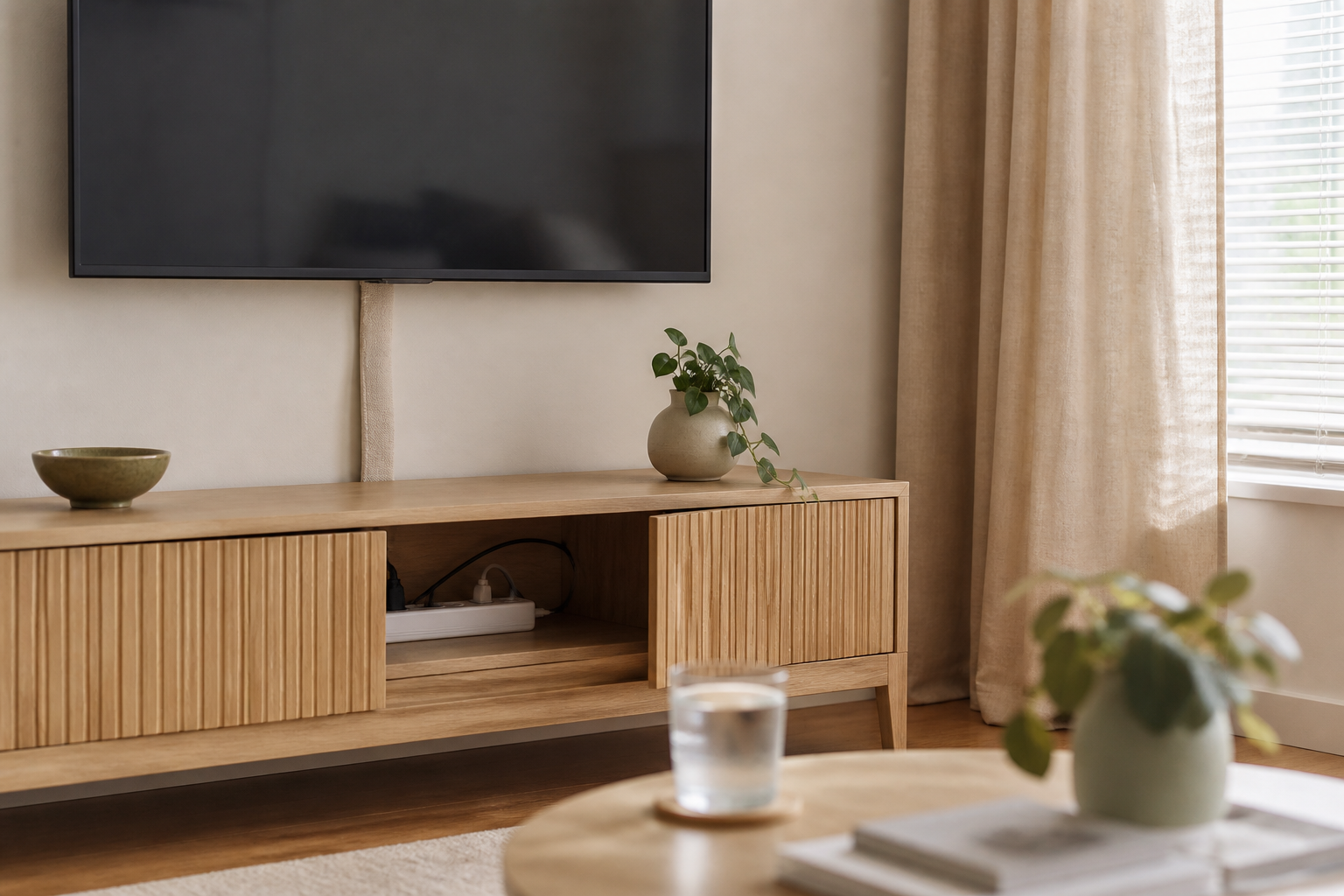
How do you hide TV wires with a console that swallows the strip?
The cabinet is there to take the strip and the bricks off the floor.
- Depth before style. A four-outlet strip is about 10–12 in (25–30 cm) long; two bricks want a 3–4 in (8–10 cm) pocket. Interior depth of 14–16 in (36–41 cm) works. An 11 in (28 cm) slim console pushes the strip onto the floor.
- Mount the strip inside. Stick or screw it to the interior back or a side, sockets facing in, cord exiting toward the room outlet. One listed strip, one wall outlet — do not daisy-chain. Leave one socket empty so a lamp can plug in later.
- Give every cable a hole. A 2 in (5 cm) grommet in the top, on the back edge, takes a sleeved bundle. Leave the cabinet 2–3 in (5–8 cm) off the wall so cords are not crushed and the mount can still tilt.
- Kill the LEDs. Face boxes away from the room, cover the LED if the manual allows, or close the doors. Blue dots read as a second screen at night.
- Style the top as a surface, not a dock. Soundbar, one low object, negative space. Remotes in a tray or inside a door. The console is furniture, like a small coffee table you can still use — not the back of the TV.
Closed storage wins. Open cubbies work only if wires stay in a back bay you never style. Do not thread cables through a styled shelf.
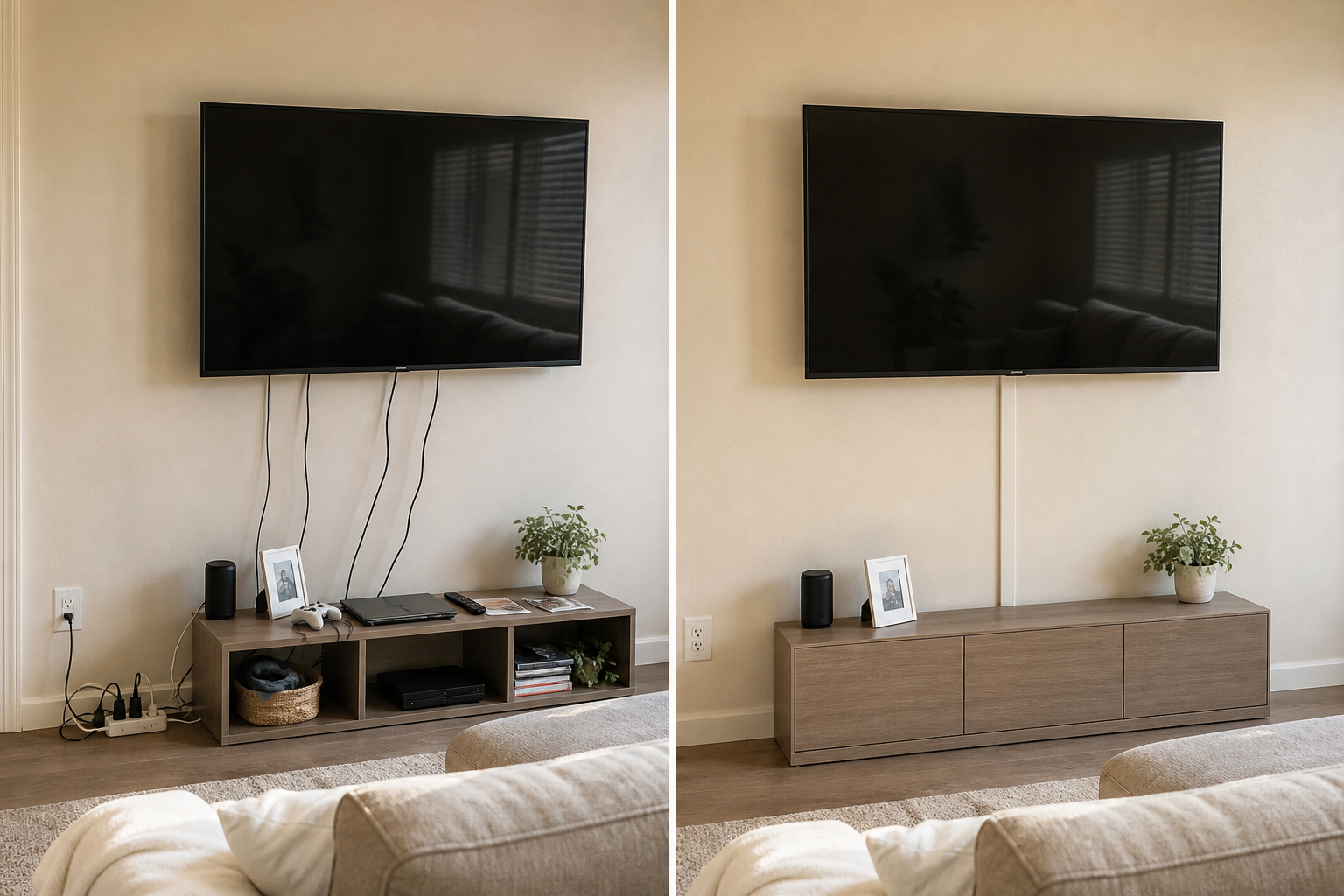
What does the same wall look like with a cable drop versus a finished media wall?
Keep the TV, the paint, and the sofa. Change only the drop and the cabinet.
The listing-photo default: TV too high, bottom 48–52 in (122–132 cm) off the floor. Three black cords to a white strip on the rug. Outlet 8–12 in (20–30 cm) off center. Console 11 in (28 cm) deep. From the sofa you see the drop first.
The same glass, finished: TV lowered so the bottom sits 4–12 in (10–30 cm) above a 14–16 in (36–41 cm) console — or a sleeved or painted drop on the centerline if the mount is fixed. Strip and bricks inside. Outlet hidden by the cabinet or a short painted elbow. Soundbar on the console. Top half empty.
That is the cheapest change that keeps a rental media wall from looking unfinished. If you later place the TV so the sofa is not a theater or float the sofa for a walkway, this quiet drop is what those layouts sit in front of.
What should you never do with TV power in a rental?
Do not run mains inside the wall.
In-wall power kits and cutting a hole above the outlet are owned-home jobs. They need the right cable, a second receptacle, and a landlord who will accept a second plate at move-out. That is not this Saturday, and it is not one of the three paths.
A 6 ft (183 cm) HDMI in a sleeve is reversible; a fish tape is not. Also skip cords under a rug, staples through a cable, a raceway across a heater or vent, daisy-chained strips, and a sleeve jammed against the TV’s vents. If the only outlet is on another wall, keep the extension on the surface and still end at a strip inside the console.
When should you stop — or skip a path?
Change the furniture plan, or hire a handyperson, when any of these is true:
- The TV sits over a fireplace with 24 in (61 cm)+ of drop and no cabinet. A long painted raceway can still work. A sleeve in mid-air will not.
- The wall failed the adhesive test (fresh paint, paper, sanded plaster). Skip path 2. Use 1 + 3.
- The console cannot come off the wall enough to clear the plug.
- Moving the drop would mean moving a radiator or a built-in. Offset the raceway at the bottom.
- You are not prepared to remove adhesive at move-out. Paths 1 and 3 leave the paint alone.
You do not need a designer. A tape, a level, a sleeve or a paintable channel, and a cabinet deep enough for a strip will do it.
FAQ
Can I hide TV wires in a rental without drilling?
Yes. Path 1 uses a clip on the TV or mount. Path 2 uses adhesive — test it. Path 3 keeps hardware inside the furniture.
Is it safe to run a TV power cord inside the wall?
Do not. Mains belong on the surface, in a listed raceway or behind furniture, plugged into a wall outlet. Use the sleeve, the painted channel, or the cabinet.
How do I hide TV wires when the outlet is not under the TV?
Under 4 in (10 cm) of offset, a sleeve can still drop into a wide console. Over 6 in (15 cm), shift the cabinet or run a painted raceway plumb from the TV and elbow sideways at console height. Do not run a diagonal cord across the wall.
Will adhesive raceway damage rental paint?
It can, on weak flat latex or fresh paint. Test a scrap for 24 hours in a hidden spot. If the test lifts film, use a sleeve plus cabinet instead.
What color should a cable sleeve or raceway be?
Match the wall if the drop sits on paint. Match the TV if it sits in the chassis shadow. One color, one bundle, on the centerline.
Do I need a media console if the TV is wall-mounted?
You need somewhere for the strip and the bricks — a 14–16 in (36–41 cm) console or a closed cabinet to the side. Path 2 hides the vertical; it does not swallow the strip.
How do I hide a soundbar cable too?
Park the bar on the console. If it is already under the TV, add its cable to the same sleeve or raceway. Its brick goes inside the cabinet.