
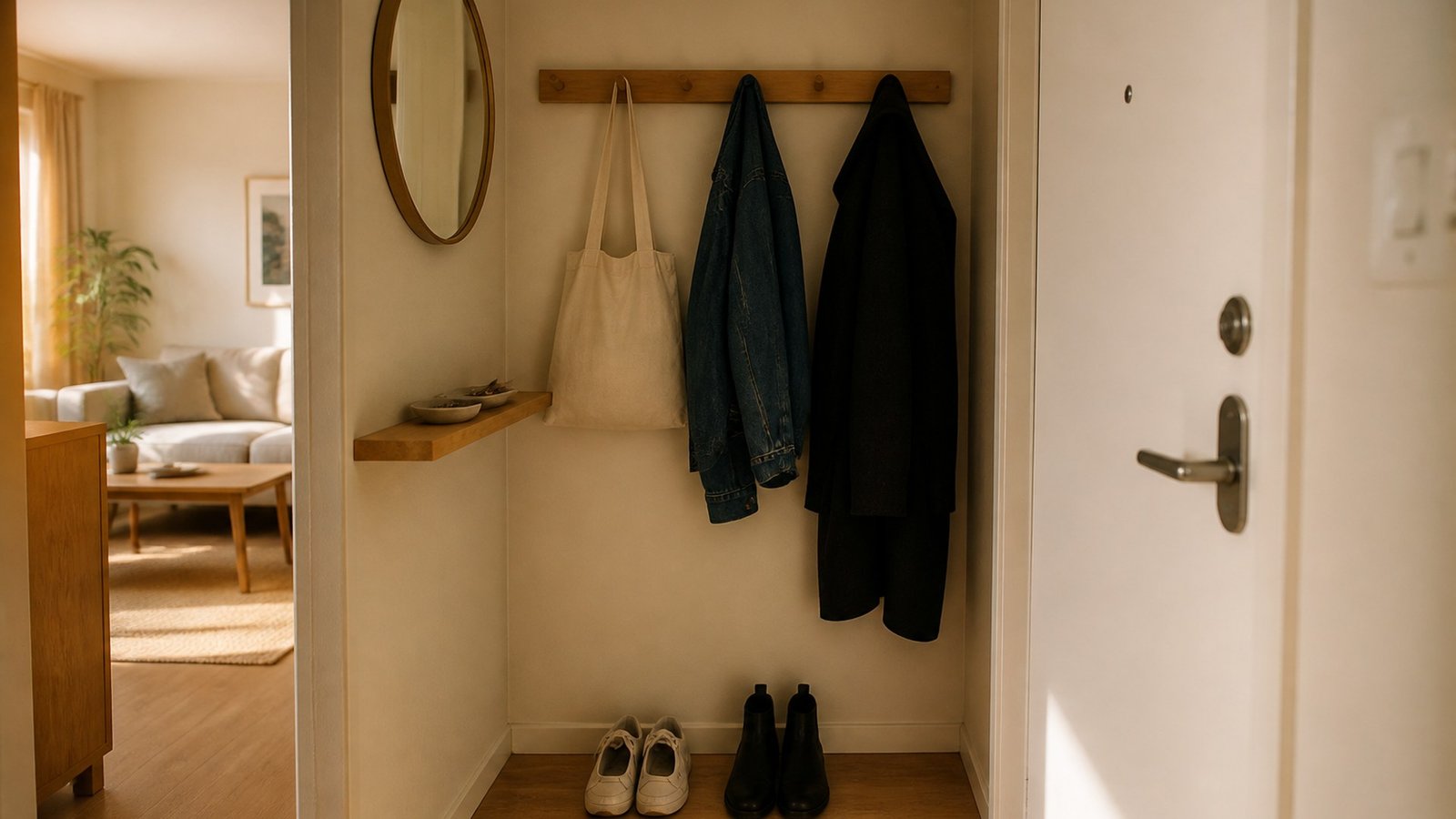
A small entryway with no closet still needs a landing pad. Skip the console table. Give one 24 in (61 cm) stretch of wall a job: a hook rail for coats and bags, a 6 in (15 cm) deep shelf for keys and mail, and a round mirror so the hall has a face. Two pairs of shoes stay visible. The rest go in a lidded box. That 24-inch kit is the closet. It is also the first thing you see, which is why the rest of the apartment starts to look intentional.
Key takeaways
- No console table. A 24 in (61 cm) wall kit (hook rail + 6 in / 15 cm shelf + round mirror) does the whole job in a hall too tight for furniture.
- Hang the rail at 62–66 in (157–168 cm) so coats clear the floor. The shelf sits immediately above it. The mirror sits above the shelf.
- Shoe rule: two pairs visible on a tray. Everything else in a lidded box. A third pair on the floor is how the landing pad dies.
- Renters: Command, tension, or two small screws into a stud. Photograph first. Weight-rate the hooks for a wet winter coat, not an empty rail.
- The landing pad is a filter, not a junk drawer. Keys, sunglasses, today’s mail. If it does not leave the house this week, it does not live here.
Why does a small entryway with no closet make the whole apartment look unfinished?
The entry is the first five seconds. If those seconds are a pile of sneakers, a coat on a dining chair, and keys on the nearest book, the apartment reads as a storage unit you happen to sleep in. You can get the living room circulation right and still lose the feeling at the door.
Most small entryway ideas start with a console, then discover the hall is 34–38 in (86–97 cm) wide and the door needs 32 in (81 cm) of swing. The table becomes a shin-hitter. You still have nowhere for the coat. Stop treating the floor as the closet. A wall can hold what a console pretends to hold, in about 24 in wide by 6 in deep (61 × 15 cm), plus a shoe tray against the baseboard.
In a studio, a calm 24-inch landing pad is the same kind of move as zoning a studio without a divider.
What is a 24-inch (61 cm) wall kit, and why skip the console table?
Three pieces on one painted rectangle. Nothing on legs.
| Part | Size | Job | Renter mount |
|---|---|---|---|
| Hook rail | 24 in (61 cm) wide, 3–5 hooks | Daily coat, one bag, a scarf. | Two screws into a stud, or rated adhesive checked for wet wool. |
| Shelf | 24 in (61 cm) wide × 6 in (15 cm) deep | Keys, sunglasses, a small dish, today’s mail. | Same fasteners, or a rail-and-shelf as one piece (two holes, not four). |
| Round mirror | 14–18 in (36–46 cm) diameter | Collar check, extra light, a circle so the hall is not all rectangles. | One hook or adhesive disc hanger. Felt behind the bottom so it cannot tick the paint. |
| Shoe tray | About 24 × 12 in (61 × 30 cm) | Two pairs visible. Wet soles off the vinyl. | Floor only. Felt pads if the floor is wood. |
| Lidded box | 12–16 in (30–41 cm) wide | Every pair that is not this week’s two. | Floor, outside the door swing. No holes. |
A console is usually 10–14 in (25–36 cm) deep before you put a bowl on it. In a 36 in (91 cm) hall, that depth leaves 22–26 in (56–66 cm) of walkway, then the door eats more. The 6 in (15 cm) shelf is a ledge, not a table.
Worked example: hall 37 in (94 cm) wide, 8 ft (244 cm) ceiling, a 32 in (81 cm) door that swings in. Hinge-side wall has 26 in (66 cm) of plaster before the kitchen casing. Latch side is the swing. Candidate rectangle: 24 in (61 cm) on the hinge side, starting 1 in (2.5 cm) off the door casing so the rail never meets the trim.
How do you measure the wall before you buy anything?
This is the tape-measure sequence. Twenty minutes. Do not shop until the tape on the wall looks boring.
- Photograph the existing mess. Door open and closed, the floor, any old hooks.
- Measure the hall rectangle. Width between baseboards, length from the door face to the next opening, floor to ceiling.
- Tape the door swing. Open the door 90°. Run painter’s tape along the outer arc. Nothing with a body (tray, box, plant) lives inside that arc.
- Pick 24 in (61 cm) on the better wall. Hinge side is usually safer. Leave at least 1 in (2.5 cm) of paint between casing and rail. If the usable plaster is only 20 in (51 cm), buy 18–20 in (46–51 cm) and keep the same stack.
- Mark obstacles. Switch, intercom, thermostat, outlet. Tape a box around each. The kit does not cover a switch.
- Find the coat length. Hold your heaviest jacket at the planned hook height. The hem should clear the floor by 4–8 in (10–20 cm) and the shoe tray by at least 2 in (5 cm). If a long wool puddles, that coat does not live on this rail.
- Tape the vertical stack. A 24 in (61 cm) strip from about 46 in (117 cm) off the floor up to about 86 in (218 cm). Mark the rail at 62–66 in (157–168 cm), the shelf underside about 4 in (10 cm) above it, and the mirror above the shelf. Live with the tape for 48 hours. Open the door with a grocery bag. If you bang the imaginary shelf, drop it 1 in (2.5 cm).
- Check the opposite wall. You need 18–24 in (46–61 cm) of clear walk once the 6 in (15 cm) shelf is on.
If the tape overlaps a switch or a peep-hole sightline, slide the whole kit 2 in (5 cm) toward the room, not toward the door.
How should you stack the hook rail, the shelf, and the round mirror?
Stack the three pieces vertically on the 24 in (61 cm) width.
Hook rail first. Mount so the hook tips sit 62–66 in (157–168 cm) from the finished floor. A standard jacket hem should hang in the air, not in the shoe tray. Three hooks beat five. Assign them: daily coat, second person or second jacket, one bag.
Shelf immediately above the rail. Leave 3–5 in (8–13 cm) of air between the top of the rail and the underside of the shelf. Shelf top lands around 68–74 in (173–188 cm). Depth is 6 in (15 cm), not 8 in (20 cm). Six inches holds a dish and a folded letter. The front edge should not pass the door casing. A rail with a built-in 6 in (15 cm) ledge is two jobs in two holes (or one set of strips).
Round mirror above the shelf. Diameter 14–18 in (36–46 cm), centered on the width. Leave 2–4 in (5–10 cm) of paint between the shelf and the bottom of the glass. On an 8 ft (244 cm) ceiling, the mirror sits in the upper third. Stand 24–30 in (61–76 cm) back and a 16 in (41 cm) glass is enough to leave the house.
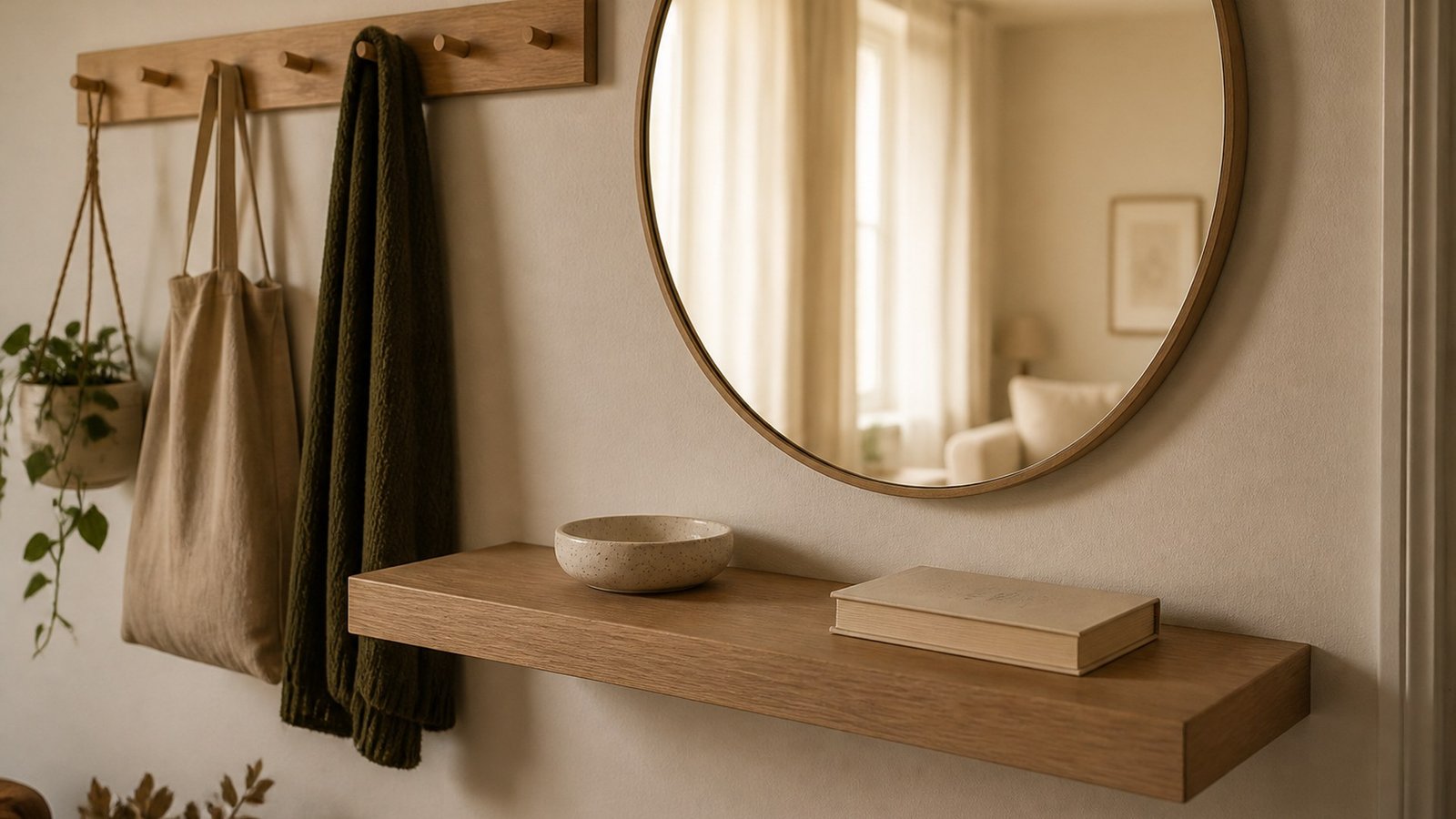
If face-check height matters more than coat length, hang the mirror center at 60–64 in (152–163 cm) and move long coats to an over-door rack.
Where do the shoes go if there is no closet?
Two pairs visible. The pair you wore today and the pair you will wear tomorrow. They sit on a low tray about 24 × 12 in (61 × 30 cm), tight to the baseboard under the rail, outside the door-swing tape. A rim of 0.5–1 in (1.3–2.5 cm) stops wet grit.
The rest boxed. A lidded box, not an open basket. Size it to leftover floor: often 14 × 11 × 11 in (36 × 28 × 28 cm) beside the tray, or a longer low box that tucks under the coats if the hems still clear it by 2 in (5 cm). Off-season pairs go under the bed. If two people share the door, the rule is still two pairs visible, not two pairs each.
Worked example: two adults, eight pairs, a 37 in (94 cm) hall. Tray holds two pairs. Box holds four. Two pairs of boots go under the bed. The entry shows four shoes and a lid.
How do you hang the kit without big holes?
Renter-safe does not mean zero holes at any cost. A peeled 4 in (10 cm) scab of eggshell is worse than two 1/8 in (3 mm) screw holes you can spackle.
First choice: two screws into a stud. Many door walls have a stud within 1–2 in (2.5–5 cm) of the casing. A 24 in (61 cm) rail can often catch one stud plus a drywall anchor on the far end.
Second choice: rated adhesive strips. Read the weight on the pack, then cut it in half in your head. A wet wool coat can be 4–8 lb (1.8–3.6 kg). Wait the full cure before you hang anything. Do not put Command on wallpaper. You will own the wallpaper.
Third choice: tension, only where the architecture allows it. A tension shelf between two parallel walls works in a hall that is a true slot, about 24–36 in (61–91 cm) across, with solid walls on both sides. An over-door hook rack is fine overflow for guests, with felt on the metal so it does not chew the door top.
Damage-risk notes, in the order they actually happen:
- Paint peel on strip removal. Warm the strip with a hair dryer on low. Pull the tab straight down, slowly, along the wall. A 1 in (2.5 cm) flake is a touch-up. A 6 in (15 cm) sheet is a patch kit.
- Plaster crumb. Pre-war plaster can blow out around a screw. Fine bit, low speed, an anchor made for plaster.
- Shelf sag. A 6 in (15 cm) shelf with books on it will lever adhesive off the wall. This shelf is not a bookshelf. If you cannot keep it to a dish and mail, you need screws.
- Mirror tick and door clash. Leave 2–4 in (5–10 cm) above the shelf so the glass never sits on wood. Two felt dots on the back. Open the door fully after you mount. If the door edge kisses the shelf, the shelf is too deep or too close to the casing.
- Kids and guests yanking. Adhesive plus a yanked backpack is a hole you did not plan. If a child uses this rail, use screws.
What actually lives on the landing pad?
The shelf is 6 in (15 cm) deep. That depth is a filter. Yes: keys in a small dish about 4–5 in (10–13 cm) across, sunglasses, today’s mail (vertical, until tonight), a transit card, one compact umbrella on a hook. No: a table lamp (the hall is the wrong place when the living room still needs a 2700K stack), a trailing plant, chargers, or a candle you will knock off with a backpack.
Extra frames go on the perpendicular wall, not inside the 24 in (61 cm). Empty the shelf every Sunday night. Swap the hall bulb to 2700K if you can reach it.
If the door opens onto the window wall, hang those curtains high and wide so the first long vertical you see is fabric, not a builder blind fighting a hook rail.
What is the move-out reverse checklist?
Work top to bottom, loaded to empty. Do not pull adhesive with a coat still on it.
- Empty every hook and the shelf. Shoes in the box. Dish in the kitchen. Leave the mirror up until the wall is empty below it.
- Photograph the installed kit and the floor so you have a record of what you are reversing.
- Take the mirror down first. Support the glass. Remove the hook or stretch the adhesive tab. Bag the hardware. Circle any paint nick with tape so you fill it later.
- Remove the shelf, then the rail. Unscrew into a cup. For adhesive, hair dryer on low, tab straight down, slow. If a strip has no tab left, floss it with dental floss behind the plate rather than prying.
- Fill holes the same day. Spackle, flush, dry, a second dab if it shrinks, sand with a fine sponge. Eggshell touch-up with a small brush.
- Peel damage. If strips took paper, glue a loose flap with a tiny amount of white glue, then touch up. If they took a sheet, patch and prime.
- Floor and door. Lift the tray. Wipe grit. Check the door top for grey metal marks and the casing for rail scars.
- Stand in the doorway and look. The wall should read as the original builder wall. Take a checkout photo in the same light as your move-in photo.
When should you skip this kit or swap a piece?
Skip the 24-inch wall, or change a part, when any of these is true:
- The only plaster is under 18 in (46 cm) wide, or it is entirely a switch-and-thermostat panel. Use an over-door rack plus a floor box, and put the mirror on the first living-room wall.
- The hall is under 30 in (76 cm) wide and a 6 in (15 cm) shelf would drop the walk below 18 in (46 cm). Drop the shelf. Keep the rail and a small mirror. Keys go in a wall pocket or a dish on the kitchen ledge 6 ft (183 cm) away.
- The wall is fresh wallpaper, crumbling plaster, or a concrete bulkhead. Do not invent a fastener. Over-door plus a standing mirror parked out of the swing is the honest path.
- You own six daily coats and will not box shoes. Edit the coats, or put a 24 in (61 cm) wardrobe in the bedroom, not the hall.
- The door is a shared building hallway with no private wall. Move the landing pad inside, still 24 in (61 cm), on the first wall after the lock. Same kit. Same shoe rule.
FAQ
What do you do with a small entryway that has no closet?
Skip the console table. Build a 24 in (61 cm) wall kit: hook rail at 62–66 in (157–168 cm), a 6 in (15 cm) deep shelf just above it, and a 14–18 in (36–46 cm) round mirror above the shelf. Two pairs of shoes on a tray. The rest in a lidded box. That is the closet.
How do you decorate a small entryway wall without furniture?
Use height, not depth. One rail, one shallow shelf, one round mirror, stacked on 24 in (61 cm) of wall. Keep the shelf to a dish and daily mail. Extra frames belong on another wall so the landing pad stays a landing pad.
Where should shoes go in a small entryway?
Two pairs visible on a low tray about 24 × 12 in (61 × 30 cm), out of the door swing. Every other pair in a lidded box, under the bed, or in a bedroom closet. A third pair on the floor is the start of the old pile.
Can renters hang entryway hooks without big holes?
Yes. Prefer two small screws into a stud if the wall allows. Otherwise use weight-rated adhesive strips and treat a wet coat as the load, not the empty rail. Tension and over-door racks are backups. Photograph, then reverse with heat and slow tabs at move-out so you do not peel paint.
What size mirror works on a 24-inch (61 cm) entry wall?
A round mirror 14–18 in (36–46 cm) across, centered on the rail, 2–4 in (5–10 cm) above the shelf. Smaller than 12 in (30 cm) looks like a peephole. Larger than 20 in (51 cm) overhangs the kit. You are checking a collar, not doing full glam.
Related: hang curtains high and wide · rental lighting stack · circulation-first furniture layout · zone a studio without a divider