# Style a Small Coffee Table You Can Still Use (The 40% Empty Rule)
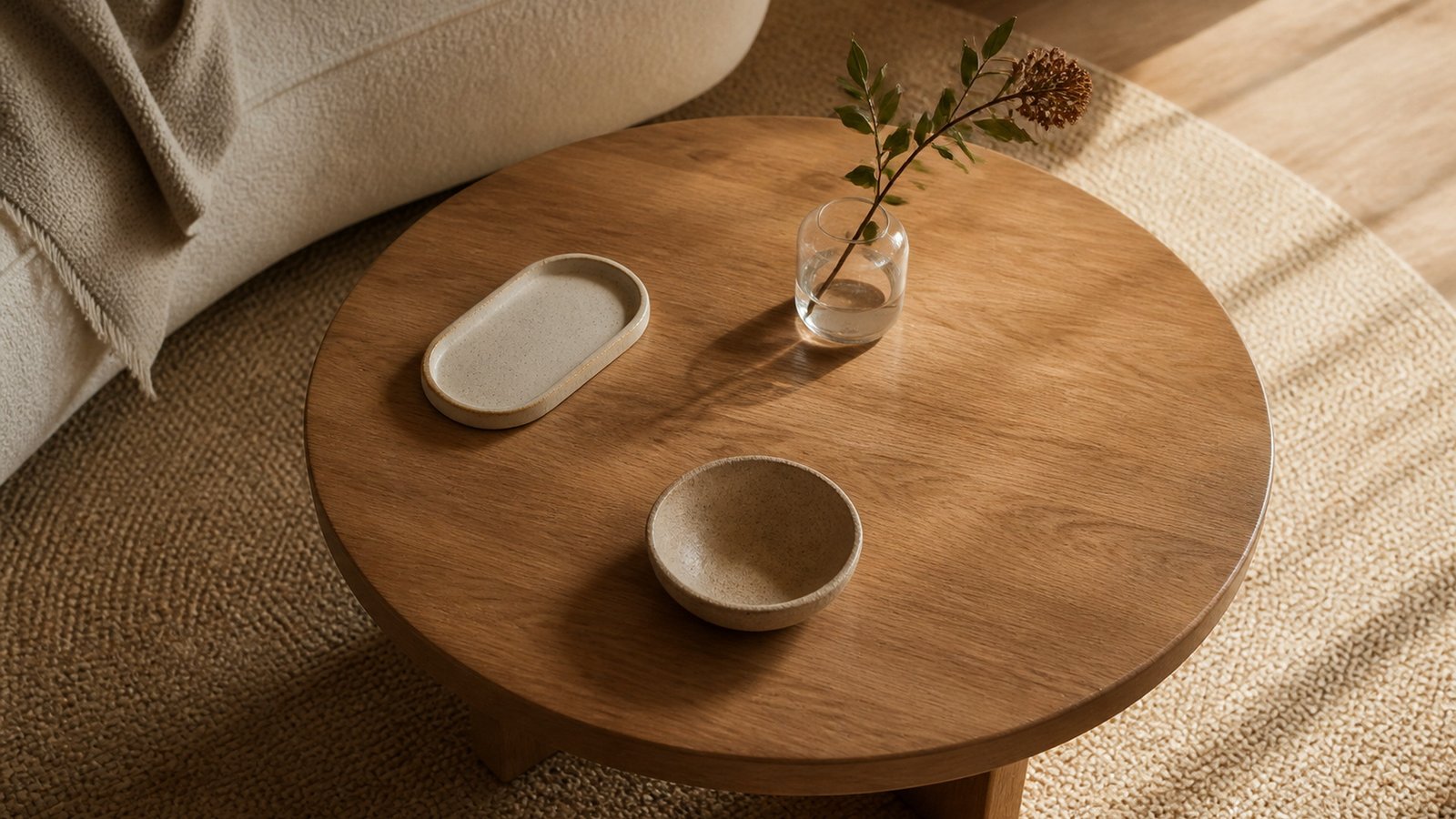
To style a small coffee table, leave 40% of the surface empty on purpose so a mug and a closed laptop still fit. Use three objects on a small footprint: one tray, one low bowl, one stem. Cluster them. Do not sprinkle. On a weeknight, a 30-second tidy puts remotes in the tray and leaves the empty zone alone.
Key takeaways
- Empty is not leftover. Reserve 40% of the top for a drink and a laptop — that is the use zone.
- Three objects only on a small table: tray (medium), low bowl, one stem (tall).
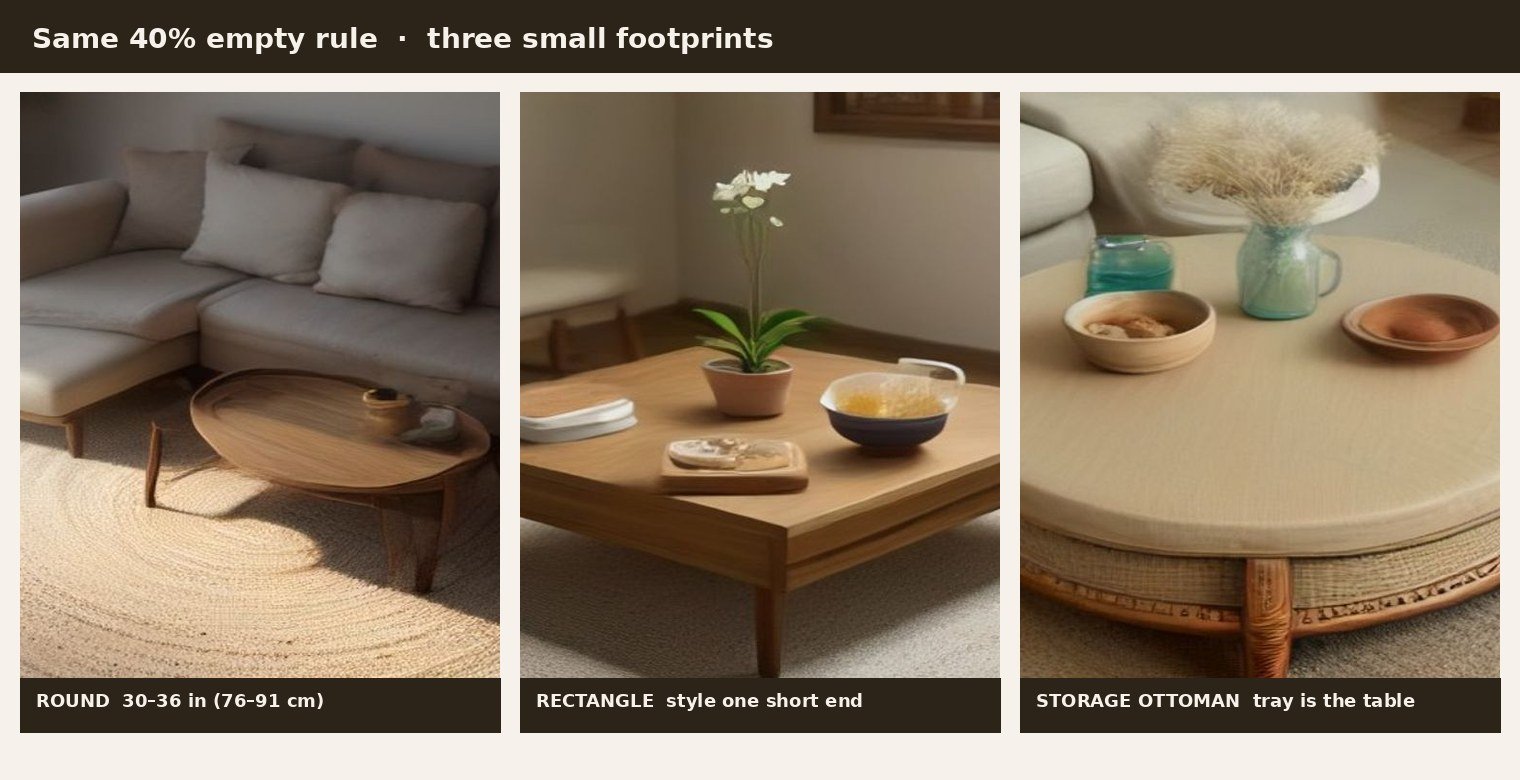
- Round 30–36 in (76–91 cm): park the cluster on one third. Compact rectangle: style one short end. Storage ottoman: the tray is the tabletop; the lid still opens.
- Sofa to table: 14–18 in (36–46 cm). Walkway past the table: 18–24 in (46–61 cm).
- Weeknight reset: remotes into the tray, mail off, 40% still empty. Styled and usable are the same surface.
Why does a small coffee table fill up so fast?
A 48–54 in (122–137 cm) rectangle can absorb a stack of books, a candle, a bowl, and still take a remote. A 30–36 in (76–91 cm) round — the table that actually fits a rental after you arrange the sofa for a walkway — cannot. Four objects plus a charger become a lid. There is nowhere to set a glass without moving a vase.
That is why most “how to style a coffee table” advice, written for a large rectangle, fails in a small living room. The top is already doing two jobs: landing pad between sofa and TV, and the only table that takes a laptop after dinner. Styling that pretends it is a display shelf will be undone every evening. The 40% empty rule styles around use, then stops.
What is the 40% empty rule?
Measure the tabletop. Forty percent of that area stays clear — no books, no coasters parked as decor, no “small extra.” That field is for a mug and a closed 13–14 in (33–36 cm) laptop, or two glasses. It is not a gap you will fill later.
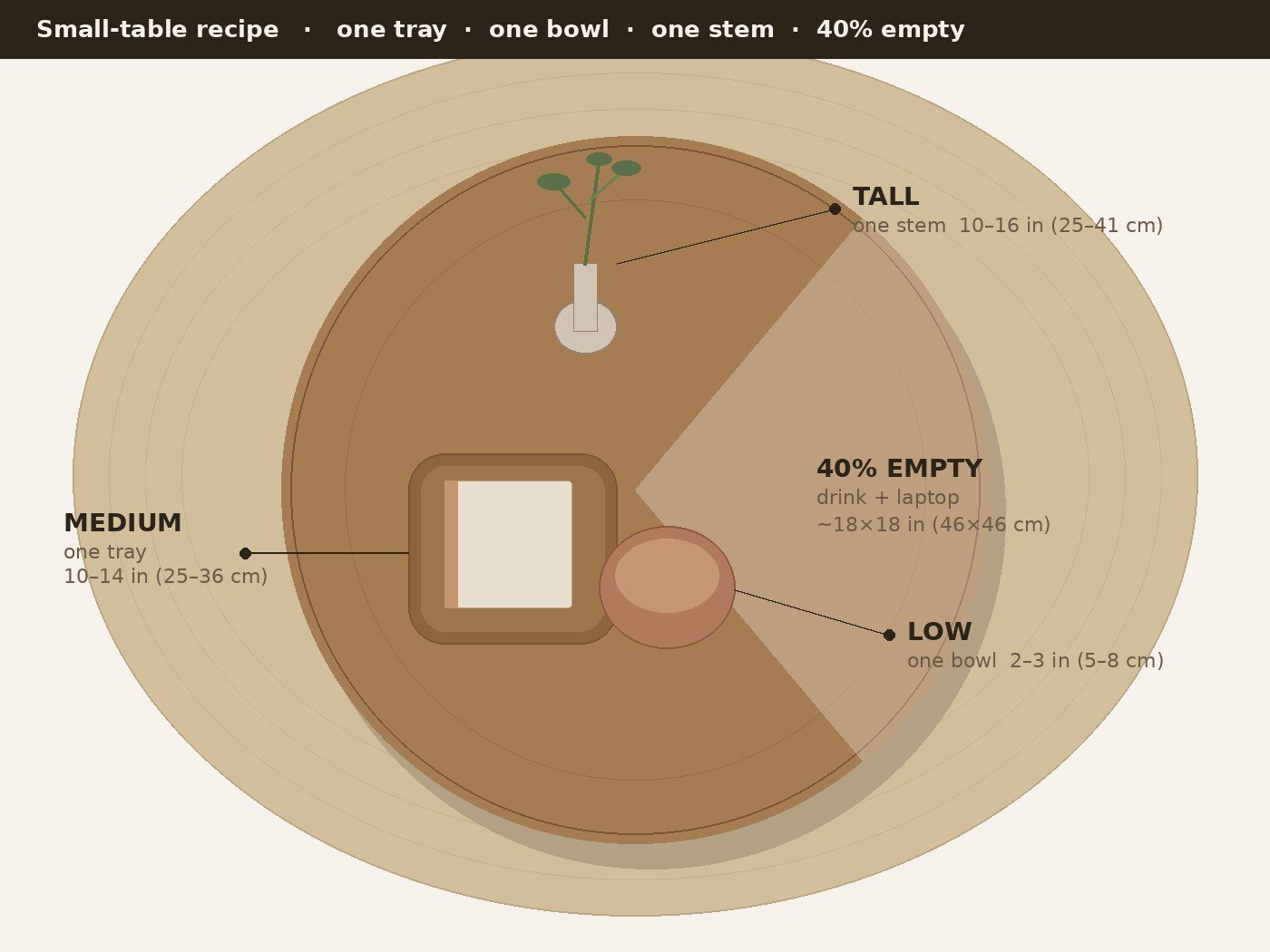
On a round 32 in (81 cm) table, the disc is about 804 sq in (5,187 cm²). Forty percent is ~322 sq in (2,075 cm²) — a patch roughly 18×18 in (46×46 cm). That is one laptop plus a mug with elbow room. The other 60% holds the cluster: tray, bowl, stem. If the cluster grows, it eats the use zone. Cut an object; do not shrink the empty.
On a compact rectangle 36×20 in (91×51 cm), forty percent is ~288 sq in (1,858 cm²) — a 16×18 in (41×46 cm) landing on the long run. Style the short end. Leave the long run. Tape the empty zone once and live with it for a week. If the laptop still ends up on the sofa arm, the zone is too small or the cluster is too greedy.
What measurements do you actually need?
Take these before you add a single object. Write them on tape under the table.
| Measurement | How to take it | Target |
|---|---|---|
| Tabletop size | Diameter (round) or L × W | Round 30–36 in (76–91 cm); compact rectangle under 40 in (102 cm) on the long side |
| Empty zone | 40% of the top, taped as a rectangle or wedge | Space for a mug and a closed laptop 13–14 in (33–36 cm) |
| Sofa to table | Seat cushion to nearest table edge | 14–18 in (36–46 cm) — shin clearance, not a stretch |
| Walkway past the table | Tightest pass to a door or kitchen | 18–24 in (46–61 cm) |
| Cluster footprint | Tray + bowl + stem base, as a group | Stay inside 60% of the top |
| Object heights | Tabletop to top of each piece | Stem 10–16 in (25–41 cm); tray stack 3–5 in (8–13 cm); bowl 2–3 in (5–8 cm) |
Worked example — 32 in (81 cm) round, 16 in (41 cm) high. Sofa 78 in (198 cm) wide. Gap sofa-to-table 16 in (41 cm). Walkway on the TV side 22 in (56 cm). Empty wedge: a 90-degree slice, or an 18×18 in (46×46 cm) square on the sofa-right. Cluster on the opposite third: oval tray 11×8 in (28×20 cm), bowl 6 in (15 cm) across, bottle 12 in (30 cm) tall with one stem. Total cluster about 14×12 in (36×30 cm). If a second book will not fit on the tray without covering the empty, skip the book.
Those sofa and walkway numbers are the same ones you use when you place a TV without turning the room into a theater. The table sits in that circulation, not on top of it.
How do you build tall, medium, and low on a small footprint?
Height variation keeps three objects from reading as clutter. Scale keeps them from eating the table. On a small top you get one of each, not a pair.
Tall — one stem. A single branch, olive, eucalyptus, or a dried grass in a slim bottle 10–16 in (25–41 cm) high. The base should be no wider than 3–4 in (8–10 cm). A bouquet wider than the bottle will shade the empty zone and catch a laptop lid. Skip a second vase.
Medium — one tray. This is the only object allowed to hold other objects. Wood, enamel, or shallow ceramic, 10–14 in (25–36 cm) on its long side. On it: one book, and that is the parked home for remotes. The tray is a fence. Anything not in it should not be on the table.
Low — one bowl. Unglazed clay, stone, or a low wood dish, 5–8 in (13–20 cm) across and 2–3 in (5–8 cm) tall. Empty, or with a few stones. Not fruit you will not eat. The bowl is a weight so the cluster does not hover.
Set them as a tight triangle, not a line. Stem at the back of the cluster, away from knees. Tray closest to the sofa so remotes are in reach. Bowl beside the tray. Leave 0.5–1 in (1.3–2.5 cm) of table between each piece so they read as three, not a pile. A candle is not a fourth object if it lives on the tray and you light it. A candle next to the tray is a fourth object — skip it on a 32 in (81 cm) round.
Color stays with the room: oat, clay, wood, one deeper green in the stem. A high-contrast black sculpture on a small pale table becomes the whole story. The window, hung high and wide, should still win.
How do you style a round coffee table, 30–36 in?
Treat the disc as a pie. The cluster owns one third. The empty owns the rest.
- Sit on the sofa and mark the use side. The empty wedge is the arc nearest your dominant hand, or nearest the seat that takes the laptop. Do not put the stem in that arc.
- Place the tray first, fully inside the styled third, 2–3 in (5–8 cm) in from the rim so a knee does not knock it. Long axis of the tray follows the curve, not a diameter across the empty.
- Add the bowl beside the tray, still in the third. If it crosses the tape, it is too big.
- Add the stem at the back of that third, toward the room, not toward your shins. From the doorway you should see real tabletop in the foreground.
- Test the laptop. Close it. Set it in the empty with a mug beside it. If either hangs off the rim, pull the cluster back as a group.
A 30 in (76 cm) round is the tight case: tray 10 in (25 cm) max, bowl 5 in (13 cm), stem still 10–14 in (25–36 cm) with a narrower bottle. Nesting tables: style only the larger top. Leave the pull-out clear. Glass tops show every cable; the tray then has to hide the remote pile from below.
How do you style a compact rectangle?
A small rectangle is easier than a round of the same area because the empty can be a true runway.
Style one short end — the 16–20 in (41–51 cm) side that is not in the main walkway. Tray, bowl, and stem live in that end zone, in the same triangle. The long run stays empty: mug, laptop, a plate. That is 40% or more on a 36×20 in (91×51 cm) or 40×22 in (102×56 cm) table.
Do not put a runner down the middle with objects on both sides. That is a dining table. Do not center a tray. A centered tray on a 20 in (51 cm) width leaves two skinny gutters you cannot use. If the rectangle is a lift-top desk, keep the cluster on a tray you can pick up in one move. The lift is the use zone.
How do you style a storage ottoman as a table?
An ottoman is a lid with a cushion. The recipe changes in one way: the tray is the table.
Choose a rimmed tray large enough to hold the bowl and the stem bottle, 14–18 in (36–46 cm) on the long side, so a mug cannot slide onto the fabric. The 40% empty is the upholstery around the tray — enough fabric showing that the piece still reads as a seat.
The lid must open. If the tray is too heavy to lift with one hand, the storage is dead. Practice the move: tray to sofa cushion, lid up, lid down, tray back. Under 10 seconds. No objects off the tray — a bowl on fabric will dump. If the ottoman is already 16–18 in (41–46 cm) and the bottle is 16 in (41 cm), you have a 32 in (81 cm) wall in the TV sightline; drop to an 8–10 in (20–25 cm) stem, or skip the stem. Keep 14–18 in (36–46 cm) from the sofa. Store extra remotes inside the ottoman. That is the point of the lid.
What does a weeknight reset look like versus styled?
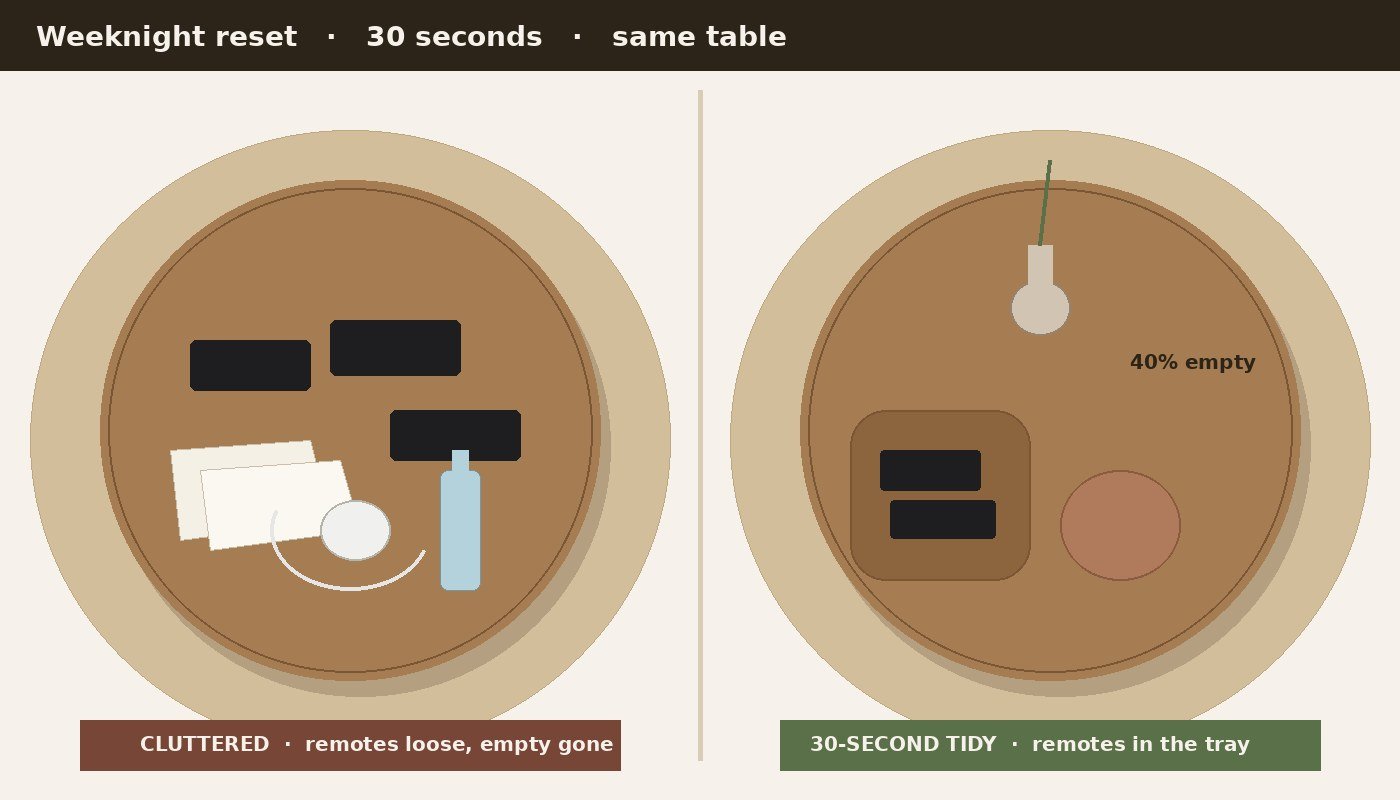
Styled is the cluster plus empty. Lived-in is the cluster plus empty plus a mug. Cluttered is when the empty disappears.
Cluttered (after a Tuesday): three remotes loose, a charging brick, yesterday’s mail, a water bottle, a candle still in shrink wrap, two coasters. The tray is buried. There is no laptop spot. From the sofa the table is a junk drawer with legs.
30-second tidy (weeknight reset):
- Mail and packaging off — kitchen counter or a bowl by the door, not “I’ll sort it here.”
- Remotes into the tray. If they do not fit, you have too many remotes, not too little table. The extra one goes in the ottoman or the console you already use to hide the TV wires.
- Water bottle to the kitchen. A mug can stay on a coaster in the empty zone.
- Laptop closed, in the empty, or off the table. Do not add a fourth object to “hold” it.
- Stop. Do not restyle. The stem and the bowl do not move.
If the reset takes more than 30 seconds, the cluster is too elaborate. Remove the extra book.
Styled (the Saturday version): same three objects, tray lined up, empty zone obvious from the doorway, no mug. It should take one minute from the tidy, not a new shopping trip. If you cannot tell tidy from styled without a candle, the recipe is doing its job.
When should you stop — or skip the cluster?
Leave the table emptier, or skip objects, when any of these is true:
- The top is under 28 in (71 cm) across. A tray and a mug. That is the whole recipe.
- Kids or a dog use the lid as a seat. Ottomans get a rimmed tray and nothing breakable. Stem off.
- You work from this table every night. Keep the tray and the empty. Skip the stem if it snags the laptop.
- The walkway is already under 18 in (46 cm). Do not add a tray that overhangs.
- You will not do the 30-second reset. An empty table with a single bowl is calmer than a half-finished formula.
Skip matched pairs (two candles, two mini plants), a second tray, anything taller than 16 in (41 cm) besides the stem, and charging cables across the empty zone. A large art book can be the only thing on the tray — if the bowl and stem then fail to fit, the book goes on the console, not on the last 40%.
You do not need a stylist. A tape, a tray you can lift, and the discipline to leave 40% blank will do it.
FAQ
How do you style a coffee table without making it unusable?
Leave 40% of the top empty as a drink-and-laptop zone. Limit the rest to one tray, one low bowl, and one stem, clustered, not spread.
How many items should be on a small coffee table?
Three styled objects, plus whatever is in use (a mug, a laptop). Remotes live in the tray, not as extra items. A fourth styled object is one too many on a 30–36 in (76–91 cm) round.
How do you style a round coffee table that is only 30–36 inches?
Use one third of the disc for the tray-bowl-stem triangle. Keep the other two thirds clear. Pull the cluster 2–3 in (5–8 cm) in from the rim so knees do not hit it.
Can a storage ottoman work as a coffee table?
Yes, if a rimmed tray is the tabletop, the lid still opens in one move, and objects stay on the tray. Store extra remotes inside. Keep 14–18 in (36–46 cm) from the sofa.
How far should a coffee table be from the sofa?
14–18 in (36–46 cm) from the seat cushion to the table edge. Closer than 12 in (30 cm) and it is a footrest. Farther than 20 in (51 cm) and you will set the mug on the floor.
What is a 30-second weeknight reset?
Mail off. Remotes in the tray. Bottle to the kitchen. Laptop in the empty zone or off the table. Do not restyle the stem and bowl. If it takes longer, remove an object.
Do I need to buy new accessories to style a coffee table?
No. A cutting board can be the tray. A cereal bowl can be the low bowl. One cutting from a houseplant is the stem. The rule is empty space and a cluster, not a shopping list.