
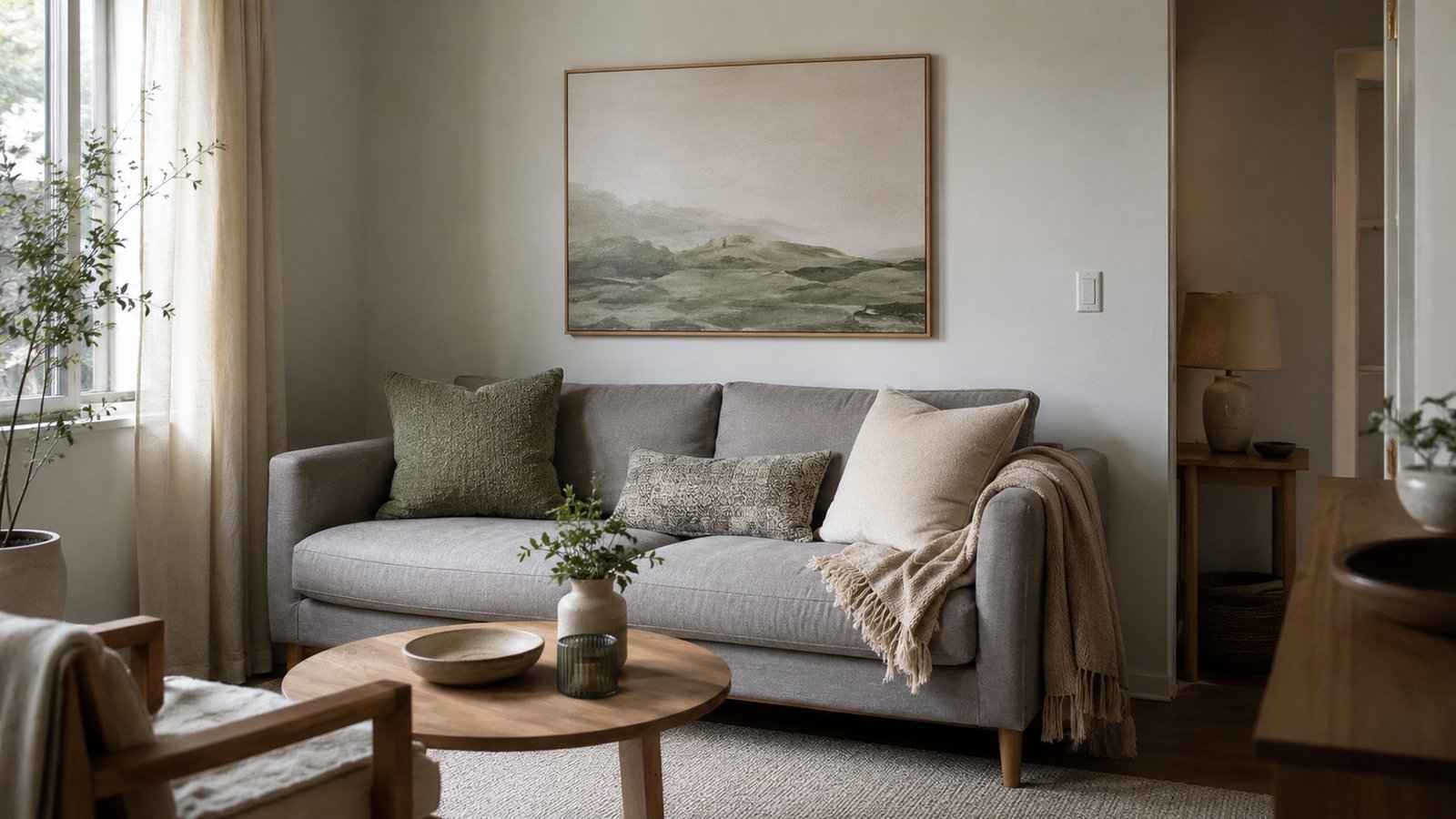
Default: hang one large piece, or lean it. Aim for art at least half the sofa or bed width, and better still 60-75%: an 84 in (213 cm) sofa wants a piece about 50-63 in (127-160 cm) wide. Climb the weight ladder from putty to adhesive strips (wait 1 hour, pull the tab straight down) to a lean with museum putty at the top edge. Skip picture-rail molding and monkey hooks unless the lease already allows pinholes. This is the calm renter recipe for how to hang pictures without nails. There is no zero-damage guarantee.
Key takeaways
- Default: one large piece at least half the sofa or bed width. Aim 60-75%. Example: 84 in / 213 cm sofa → art about 50-63 in / 127-160 cm wide.
- Weight ladder: putty for light frames → adhesive strips (wait 1 hour, pull tab straight down) → lean plus museum putty at the top edge for heavy or textured walls.
- Note the 57 in (145 cm) center, then override for a sofa-back hang: leave about 6-10 in (15-25 cm) from sofa back to the bottom of the frame.
- Gallery walls are the exception. Count strips (or holes) before you start. Nine small frames cost far more risk than one large piece.
- Skip picture-rail molding and monkey hooks unless the lease allows pinholes. Skip heavy orange-peel for strips. No zero-damage guarantee.
Why one large piece instead of a gallery wall in a rental?
A salon hang looks generous in a catalog. In a small rental it multiplies contact points. Each extra frame is another pair of strips, another chance of paint lift, another thing to pack. One large piece fills the wall above the sofa or bed so the room does not look unfinished. That is the same edit that makes a small room look bigger: fewer objects, honest scale, more air.
At least half the furniture width is the floor. Below half, the art reads as a postage stamp and you will be tempted to add more. Sixty to seventy-five percent is the keep. Above about 80% the frame competes with the sofa arms, the opposite of a warm Scandinavian living room that stays quiet in 200 square feet. If the frame is heavy, the wall is textured, or the deposit is already tight, lean the same large piece and lock the top edge with museum putty. Gallery walls stay as the exception, with a strip-count compare later. They are not the default for how to hang pictures without nails.
How wide should art be above a sofa or bed?
Measure the sofa or bed first, not the wall. Write the width in inches and centimeters. Multiply by 0.60 and by 0.75. Those two numbers are your shopping window.
A typical rental sofa is about 72-84 in (183-213 cm) wide, the same range used when you warm a grey rental sofa. At 72 in (183 cm), 60-75% is about 43-54 in (109-137 cm). At 84 in (213 cm), 60-75% is about 50-63 in (127-160 cm). A 24 in (61 cm) print over an 84 in sofa is a stamp. A 54 in (137 cm) piece is the keep.
Bedroom math uses the mattress. A queen is 60 in (152 cm) wide, so art about 36-45 in (91-114 cm). A king is 76 in (193 cm), so art about 46-57 in (117-145 cm). A twin near 38 in (97 cm) wants about 23-29 in (58-74 cm), often one calm print above a tiny nightstand wall, not a triptych. Height is secondary: about 24-36 in (61-91 cm) tall fits most sofa-back gaps under an 8 ft (244 cm) ceiling. If you only find a tall narrow frame, lean it. Do not add two small frames for “balance.” If two pieces both sit in the 60-75% window, pick the quieter one, the same restraint as styling a shallow bookshelf.
How do you hang pictures without nails, step by step?
Start with the wall and the weight. Dust the paint. Press your palm flat. Heavy orange-peel, knockdown, or brick: skip adhesive strips and go to lean plus museum putty. Smooth or light texture: climb the ladder.
Rung 1: putty. Poster putty or museum putty for unframed prints and very light frames, often under about 1-2 lb (0.5-0.9 kg). Use pea-size dots at the corners, not one center blob. Fine for a lightweight print in an entry with no closet, not for a 50 in canvas. No pack rating means light duty only.
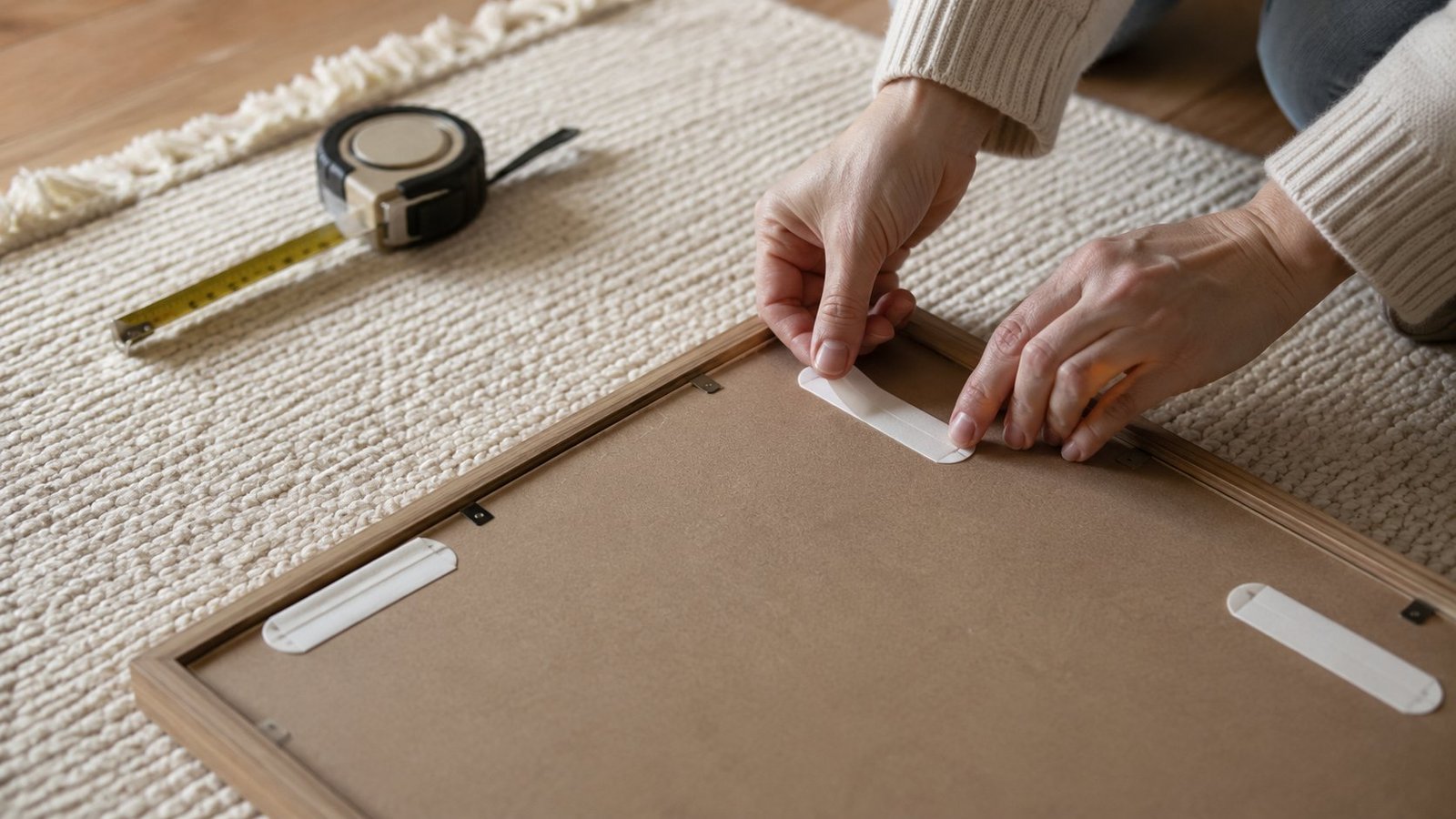
Rung 2: adhesive strips. The usual answer for how to hang pictures without nails on smooth painted drywall. Match the pack weight to the frame. A common large-strip pack holds about 16 lb (7.3 kg) when you use the stated number of pairs. Weigh the frame with glass if you are unsure. Clean the wall with isopropyl alcohol, let it dry, press each strip about 30 seconds, then wait 1 hour before hanging. That hour is not optional. After the wait, press the frame on and hold 30 seconds. To remove, stretch the tab slowly straight down, close to the wall. Never yank outward. Outward pull lifts paint.
Rung 3: lean plus museum putty at the top edge. For heavy frames, textured walls, or deposit anxiety. Sit the bottom on the floor, a mantel, a console, or a shallow shelf. Tip the top to the wall. Press putty at both top corners so it cannot skate. Keep the 60-75% width rule. A tiny frame leaned on the floor looks lost.
Tools: tape measure, painter tape for a mock rectangle, isopropyl alcohol, a level, a bathroom scale, museum putty, rated strips, and a soft cloth. Skip nails and liquid adhesive.
How high should the center sit, and when do you override 57 inches?
The museum default is the center of the artwork at 57 in (145 cm) from the finished floor. Remember it. Then override it above a sofa or a bed. Furniture changes the eye line.
Sofa-back hang: leave about 6-10 in (15-25 cm) of wall between the sofa back and the bottom of the frame. A typical rental sofa back sits about 30-34 in (76-86 cm) from the floor, so the bottom of the art lands near 36-44 in (91-112 cm). A 30 in (76 cm) tall piece then has its center near 51-59 in (130-150 cm), close to 57 in. If the sofa back is higher, trust the 6-10 in gap. Bed hang: the same 6-10 in (15-25 cm) above the headboard, not above the mattress.
Empty wall with no sofa: use 57 in (145 cm) to the center. In a dark room, keep the art in a warm lamp pool, the same idea as how you decorate a dark apartment. Tape a paper rectangle, live with it for a day, and sit on the sofa. Circulation still comes first when you arrange furniture in a small living room. Art should not force you to duck a corner in a 30-36 in (76-91 cm) walk.
When should you lean art instead of hanging it?
Lean when the frame is heavier than your strip pack, the wall is textured, the paint is under about 30 days of cure, adhesive is not allowed, or you do not want a removal story. A large piece on the floor against a sofa wall is a known, calm hang. It also travels.
Floor lean: bottom on the floor or a thin rug, top to the wall, museum putty at both top corners. Keep the 30-36 in (76-91 cm) walk clear. If the sofa sits 6-10 in (15-25 cm) off the wall, the lean can sit in that pocket as long as the art still reads as 60-75% of the sofa. If it disappears behind cushions, the piece is too short. Shelf lean: a console or picture ledge about 3-4 in (8-10 cm) deep can hold the bottom. Still putty the top. Do not lean a 12 in (30 cm) print next to an 84 in sofa. Lean big, or hang one big piece.
Is a gallery wall worth the extra strips?
Sometimes, in a long blank hall, or when you already own the small frames. Treat it as the exception and count before you peel the first liner.
Hole-count compare, if someone used nails: one large frame is often 1-2 holes. A nine-frame gallery is often 9-18 holes. Strip-count compare: one large frame might use 4-8 large strips (two to four pairs). A nine-frame gallery of 8 × 10 in (20 × 25 cm) frames can use 18-36 small or medium strips. Each strip is a contact patch that can lift paint. If you still want a cluster, cap it at three frames whose combined width sits in the 60-75% window, with gaps of about 2-3 in (5-8 cm). Do not mix nails and strips on the same wall.
What about textured walls, picture rails, and monkey hooks?
Heavy orange-peel, knockdown, and brick are a skip for adhesive strips. The adhesive only kisses the peaks. Frames creep, then fall, then take paint. Light orange-peel is a maybe after a closet test strip for 24 hours. If it holds and peels clean, proceed on that wall only, still inside the weight rating. If it lifts paint, stop and lean.
Picture-rail molding is a skip unless the rail is already in the unit. Installing a rail is a renovation. If an old building already has one, use the hooks that came with that system. Monkey hooks make a small hole. Use them only if the lease already allows pinholes and you will fill them. If the lease says no holes, they are a skip. Putty, strips, or lean are the honest set. Fresh paint under 30 days is a skip for strips. Adhesive on soft paint is how deposits disappear. Honesty beats a removable slogan on the pack.
What should you keep, and what should you skip?
| Keep | Skip |
|---|---|
| One large piece at 60-75% of sofa or bed width | Nine-frame gallery as the default |
| 84 in (213 cm) sofa → art about 50-63 in (127-160 cm) | A 24 in print over a full sofa |
| Putty → strips (wait 1 hour, tab straight down) → lean plus putty | Nails, liquid adhesive, mixed methods on one wall |
| 6-10 in (15-25 cm) above the sofa back; 57 in center only on empty walls | True 57 in center that collides with cushions |
| Smooth, cured paint; lean on heavy texture | Strips on heavy orange-peel, brick, or paint under 30 days |
| Picture rail only if it already exists; monkey hooks only if pinholes are allowed | Installing a rail, or calling pin hooks “no damage” |
Competitors love seven-way lists: washi tape, clothespins, bulletin boards, rails, hooks, strips, lean. A small rental needs one decision tree. Keep walk paths near 30-36 in (76-91 cm) when you pull the sofa out to work. Washi tape belongs on a fridge, not as the main hang above an 84 in sofa. If the living room already leans warm grey textiles, one quiet large print is enough.
What does a weekend hang look like?
Saturday morning: measure the sofa or bed. Write 60% and 75% in inches and centimeters. For an 84 in (213 cm) sofa, that is 50-63 in (127-160 cm). Tape a paper rectangle. Check texture with your palm. Check paint age. Weigh the frame if you own it.
Saturday midday: choose the rung. Light print, putty. Medium frame on smooth paint, adhesive strips. Heavy frame, texture, or nerves, lean plus museum putty. If you use strips, clean with alcohol, press 30 seconds, and start the 1-hour wait. Do not hang yet.
Saturday afternoon: after the hour, hang and hold 30 seconds, or set the lean and lock the top corners. Check the 6-10 in (15-25 cm) sofa-back gap and the walk. Leave it overnight. Sunday, look again in daylight and under a warm lamp. If a corner lifts, take it down, add strips or putty, and wait another hour. If the wall is wrong for strips, switch to a lean. Do not add nails “just this once.”
That is the method: one large piece at 60-75% of the furniture width, or a lean of the same size. Putty, then strips with a 1-hour wait and a straight-down tab, then lean. Override 57 in above a sofa. Count strips before a gallery. Skip rails and monkey hooks unless the lease already says yes. Plan touch-up paint. No zero-damage guarantee.
FAQ
How do you hang pictures without nails in a rental?
Pick one large piece at 60-75% of sofa or bed width, then climb a weight ladder. Use putty for light prints, adhesive strips on smooth cured paint after a 1-hour wait, or lean the frame and lock the top edge with museum putty. Pull strip tabs straight down to remove. Skip picture rails and monkey hooks unless the lease allows pinholes. No zero-damage guarantee.
What is the best way to hang a large painting without damaging walls?
Match method to weight and wall. A large painting over about 10-16 lb (4.5-7.3 kg), or any piece on heavy texture, should lean with museum putty at the top corners rather than fight a strip pack. On smooth, fully cured paint, use enough adhesive pairs for the weighed frame, wait 1 hour, then hang. A 50-63 in (127-160 cm) piece over an 84 in sofa is the scale keep. Do not default to a nail in a stud.
Can you hang pictures in a rental without nails?
Yes, with limits. Putty, rated adhesive strips, and a lean are the honest toolkit. They can still lift paint, especially on fresh or flat landlord paint and on texture. Read the lease. Test a strip in a closet if you are unsure. Keep touch-up paint in the same sheen. “Without nails” is not the same as “without any trace.”
How wide should art be above a sofa, in inches and centimeters?
At least half the sofa width, and better still 60-75%. An 84 in (213 cm) sofa wants art about 50-63 in (127-160 cm) wide. A 72 in (183 cm) sofa wants about 43-54 in (109-137 cm). A queen bed at 60 in (152 cm) wants about 36-45 in (91-114 cm). Below half, the piece looks like a stamp and invites a gallery you do not need.
How long should adhesive strips wait, and when do you lean instead?
Wait 1 hour after pressing strips to the wall before you hang the frame. Pull the tab slowly straight down at move-out. Lean plus museum putty at the top edge when the frame exceeds the strip rating, when the wall is heavy orange-peel or brick, when paint is under 30 days old, or when you want zero strip contact. Textured walls are a skip for strips, not a challenge to win.
Related: what makes a small room look bigger · warm a grey rental sofa · circulation-first furniture layout · warm Scandinavian living room · style a shallow bookshelf · style a tiny nightstand · small entryway, no closet · decorate a dark apartment