
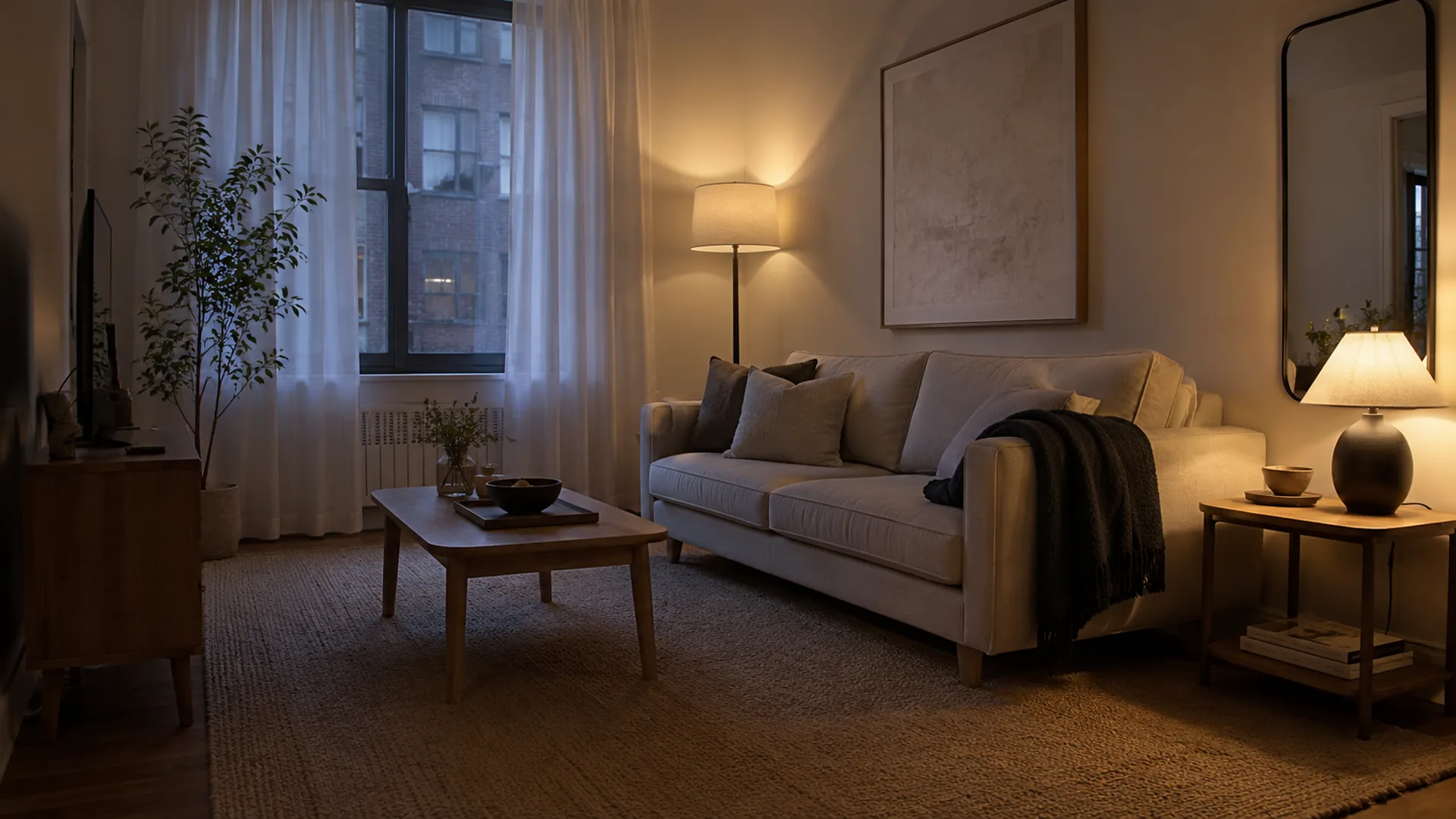
To decorate a dark apartment without pretending you have a skylight, stop fighting the gloom with cool-white LEDs. Bounce the daylight you have, hang sheers high and wide, build warm 2700K pools at three heights, keep one pale large surface, and optionally deepen one wall for a cocoon. Paint is optional. Fabric and light come first. This is a renter sequence for north-facing, courtyard, and basement-feel rooms, not a renovation brief.
Key takeaways
- Do not “fix” darkness with 4000K bulbs. Use 2700K everywhere you sit, cook, and sleep.
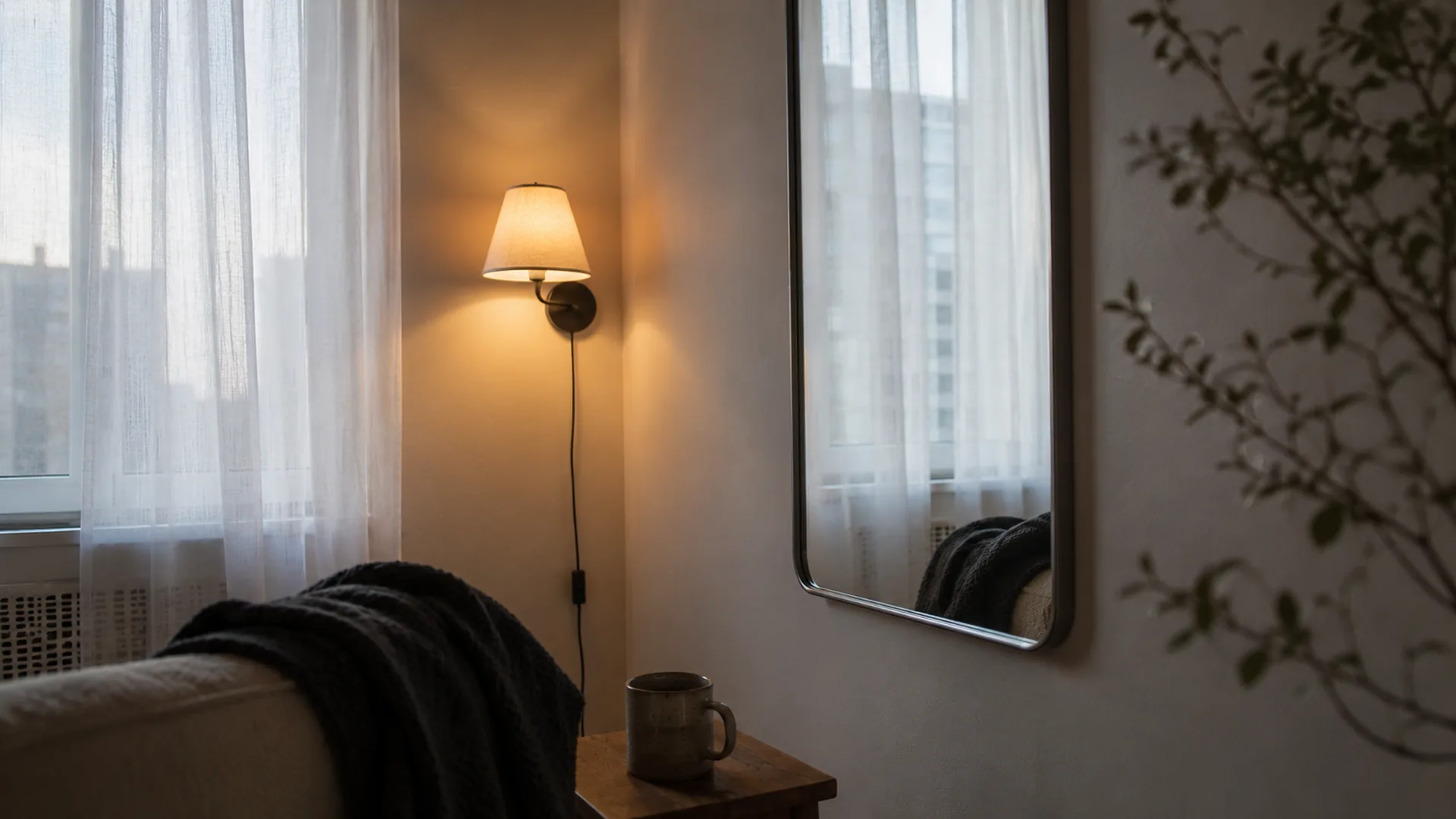
- Bounce daylight: a mirror 24–36 in (61–91 cm) across, hung opposite the brightest window, about 60–65 in (152–165 cm) to center.
- Sheer layers first, then optional blackout behind. Rod high and wide, same as any calm room.
- Three light heights: floor 48–65 in (122–165 cm), table 18–24 in (46–61 cm), plug-in sconce near seated eye level. Dim with smart plugs, not rewiring.
- One pale large surface (rug, sofa, or sheer wall of fabric). One deeper textile or wall for weight. Skip an all-white box and skip RGB strips.
Why does a dark apartment feel smaller than it is?
Low daylight removes edges. Without clear corners and warm pools, a 10 × 12 ft (305 × 366 cm) room reads as a cave. Cool overhead globes make it worse: they flatten faces, turn beige walls grey, and push you toward more shopping that never fixes the light.
Dark apartments are usually north-facing, courtyard-facing, ground-floor with trees, or railroad plans with one bright end. The floor plan is fine. The light map is not. Treat light as layout, the same way you arrange furniture from circulation first. Measure the brightest window. Measure how far soft daylight reaches at noon. That line is where your sitting pool should start, not where you give up.
Perceived size comes from contrast and from continuous floor. A postage-stamp rug under a dark sofa shrinks the room twice. Keep front legs on a larger rug, per the front-legs-on rug rule, in a pale or mid tone so the floor still reads as one plane when the window is weak.
Should you paint a dark rental white?
Only if the lease allows it and you already fixed light and textiles. All-white paint under a 4000K globe still looks institutional. Warm off-white or a soft stone can help on the wall opposite the window. A deeper wall on the darkest side can help more than a full white box, because it turns the room into a cocoon instead of a failed sunroom.
If you cannot paint, fake the pale plane with fabric and furniture: a large oat sofa, a pale rug that holds the seating group, and sheers that read as a soft wall of light. A peel-and-stick sample on one chimney breast is enough to test tone. Do not wrap the whole studio in cold bright white vinyl. Calm beats “bright” that still feels wrong at 7 p.m.
Skip glossy white on every surface. Specular glare from a single window in a dark room is harsh, not generous. Matte and linen diffuse. That is the finish you want when daylight is scarce.
How do you bounce daylight in a north-facing room?
Put a mirror where it can see the sky or the brightest patch of courtyard, not where it only sees a blank wall. Opposite the main window is the default. Size matters: about 24–36 in (61–91 cm) across for a living room, or a leaner 20 × 30 in (51 × 76 cm) rectangle if the wall is narrow. Hang so the center sits near 60–65 in (152–165 cm) from the floor, or lean a large piece if drilling is limited.
Keep the mirror glass clean. A dusty mirror in a dark room is just another dark object. Leave 4–6 in (10–15 cm) from the frame to any adjacent art so the bounce surface stays one clear shape. Do not mosaic four tiny mirrors. One calm rectangle beats a disco wall.
If the brightest window is in the kitchen and the living zone is dim, bounce toward the sitting area with a tall pale surface: a white or oat bookcase back, a large pale print, or a sheer hung to catch cross-light. The goal is a readable face of the room at noon, not Instagram noon in January.
What window layers work when the view is a courtyard?
Sheers first. They catch and spread weak daylight. Hang the rod high and wide so the glass looks larger than the frame, using the same high-and-wide rental curtain method: about 4–6 in (10–15 cm) above the frame or at the ceiling, 8–12 in (20–30 cm) past each side, panels that kiss the floor, fabric about 2× the window width.
Add a second layer only if you need sleep or privacy: a quiet blackout or linen panel on the same rod or a double rod, parked stacked off the glass by day. Skip heavy velvet on a tiny north window unless the room is a bedroom and you want a cocoon on purpose. Velvet drinks light. In a dark living room it can tip the space into evening at 2 p.m.
Leave builder blinds up if the lease wants them. Mount your rod above them. The stack of sheer plus blind is normal in rentals. What looks unfinished is a bare frame with a lonely roller shade halfway down.
How do you build a 2700K lighting stack in a dark rental?
Follow the rental lighting stack, then add one extra pool where the room goes black after sunset. Swap every bulb you control to 2700K, warm white, preferably dimmable. Three heights:
| Height | What to use | Rough size |
|---|---|---|
| High / ambient | Paper floor lamp or torchiere in a corner, not aimed at eyes | Shade top around 60–65 in (152–165 cm) |
| Mid / task | Table lamp on a console or shelf | Lamp about 18–24 in (46–61 cm) tall |
| Low / wall | Plug-in sconce or picture light, cord down the side | Center near seated eye level, about 48–54 in (122–137 cm) |
Put the floor lamp where daylight dies first, often the corner farthest from the window. Put the table lamp where you actually sit with a book or laptop. Put the sconce where a dark wall used to swallow the sofa. Dim with a smart plug or a cord dimmer. Do not open walls for new circuits.
Measure lumen mood with your eyes at 8 p.m., not with a shopping cart. Two warm lamps often beat five cool ones. Skip RGB under-cabinet strips and color-changing bulbs in the main room. They photograph as toys and they break the calm you are building. If the TV wall is the darkest wall, keep the set calm with a layout that still feels like a sitting room, and hide the cable drop with a renter-safe wire path.
Which surfaces should stay pale, and which can go deep?
Keep one large pale plane so the room still has a “sky.” Best candidates: the rug, the sofa, or the sheer wall of fabric at the window. Mid-tone wood floors help more than you think; do not cover every inch with a charcoal rug.
Add one deeper stop for weight: a charcoal throw, a forest pillow, a dark ceramic lamp, or one deeper painted or fabric wall if allowed. The same dark-object rule that finishes a warm Scandinavian living room applies here. Without a dark stop, pale rooms in weak light look dusty, not serene.
Furniture on legs helps a dark floor stay readable. A skirted sofa that sits hard on a dark rug becomes a blob. Aim for 4–8 in (10–20 cm) of visible leg. Keep walkways about 18–24 in (46–61 cm) in a small plan; do not choke the path with a bulky console that blocks the bounce path from window to mirror.
How should you place furniture when one end of the room is brighter?
Put the main seat where you can see both the window and a warm lamp after dark. Do not put the sofa’s back to the only light unless the plan forces it. In a railroad layout, park living in the brighter bay and sleep or storage in the darker bay, then pull warm light into the dark bay so it does not feel like a hallway closet.
Float the seating group on a rug that is large enough for front legs. Leave the coffee table gap about 14–18 in (36–46 cm) in a tight room. Style the table with the 40% empty rule so the surface does not add visual noise when the light is already low.
Bookcases in a dark room need air. Style a shallow Billy with one empty cubby and quiet spines, not a gift shop of objects, using the shallow bookshelf formula. A packed case on a dark wall becomes a black grid. One empty cubby and a 2700K lamp within 24–36 in (61–91 cm) keep it furniture.
What about kitchens, entries, and bedrooms that never see sun?
Kitchen: under-cabinet warm LEDs at 2700K if you can use adhesive bars the lease allows, plus one counter lamp. Swap the builder globe if the fixture takes a bulb. Matte pale runners beat glossy dark ones that disappear at night.
Entry: even a 24-inch wall needs a warm bulb and a mirror. Use the 24-inch entry wall kit so the first step inside is lit and intentional. A dark entry trains your eye to expect gloom in the rest of the apartment.
Bedroom: blackout for sleep is fine. Add a plug-in sconce or a small lamp so you are not stuck with a cool overhead at 10 p.m. Keep textiles tonal. One art piece is enough. Storage that closes beats open piles that read as shadows.
Studios: zone with rug edge, sofa back, and light, not a bulky divider that eats floor and light. The no-divider studio zoning method matters more in a dark studio, because every square foot of floor that stays open still catches bounce.
What should you skip in a dark apartment?
Skip cool daylight bulbs “to fake the sun.” They make evenings clinical. Skip glossy white everything. Skip tiny dark rugs. Skip heavy pattern on every textile. Skip RGB. Skip covering the only window with thick drapery all day. Skip buying five more lamps before you swap the bulbs you already own to 2700K.
Also skip fighting a north window with more mirrors than walls. One bounce surface is a tool. A mirrored gallery is noise. And skip the idea that a dark apartment must become pale Scandinavian cosplay. Warm, quiet, and layered reads better than a failed bright box. The tricks that make a small room look bigger still apply: high curtains, correct rug scale, furniture on legs, layered warm light. Bigger here means clearer, not colder.
What does a weekend fix look like in a 10 by 12 foot dark rental?
Room: 10 × 12 ft (305 × 366 cm), one north window about 36 × 54 in (91 × 137 cm), builder blinds, cool globe overhead, charcoal sofa against the dark wall, 5 × 7 ft (152 × 213 cm) rug floating like a stamp.
Saturday morning: measure the window and tape a rod line high and wide. Hang oat sheers that kiss the floor. Swap every bulb to 2700K. Place a 30 in (76 cm) round or rectangular mirror opposite the window, center near 62 in (157 cm). Move the sofa so front legs sit on an 8 × 10 ft (244 × 305 cm) oat or jute rug if it fits, or the largest rug that still leaves a walk. Add a floor lamp in the dark corner and a table lamp by the seat. Sunday: one charcoal throw, one pale pillow, coffee table edited to 40% empty, bookshelves emptied of merch.
At noon the sheers and mirror give you a readable wall. At 8 p.m. two warm pools and a dimmed overhead (or the overhead off) make the room feel finished. That is decorating a dark apartment without a skylight: bounce, sheer, 2700K, one pale plane, one deep stop.
FAQ
How do you decorate a dark apartment without painting?
Swap bulbs to 2700K, hang sheers high and wide, place one large pale mirror opposite the brightest window, use a pale rug with front legs on, and add three lamp heights. Paint is optional. Fabric and light do most of the work in a rental.
What color light bulbs are best for a dark apartment?
Use 2700K warm white in every lamp you control. Avoid 4000K and “daylight” bulbs in living and sleep zones. Dim with smart plugs. Layer a floor lamp, a table lamp, and a plug-in sconce instead of relying on the builder globe.
Where should you put a mirror in a dark room?
Opposite the brightest window, sized about 24–36 in (61–91 cm) across, center near 60–65 in (152–165 cm) from the floor. One calm mirror beats a cluster of small ones. Keep it clean so it actually bounces light.
Do dark walls make a small apartment feel smaller?
Not always. One deeper wall or textile can cocoon a north-facing room and look intentional. What shrinks the room is a tiny dark rug, cool overhead light, and no bounce surface. Pair any deep color with warm 2700K pools and one pale large plane.
How can renters add lighting without hardwiring?
Use plug-in sconces, corded floor and table lamps, adhesive under-cabinet bars where allowed, and smart plugs for dimming. Follow a three-height stack. Do not run new mains inside the wall. Hide cords neatly along baseboards or furniture backs.
Related: the rental lighting stack · hang curtains high and wide · what makes a small room look bigger · rug size, front legs on · circulation-first furniture layout · style a small coffee table · style a shallow bookshelf · warm Scandinavian living room · small living room with a TV · hide TV wires in a rental · zone a studio without a divider · small entryway, no closet · office design trends 2026, small home