
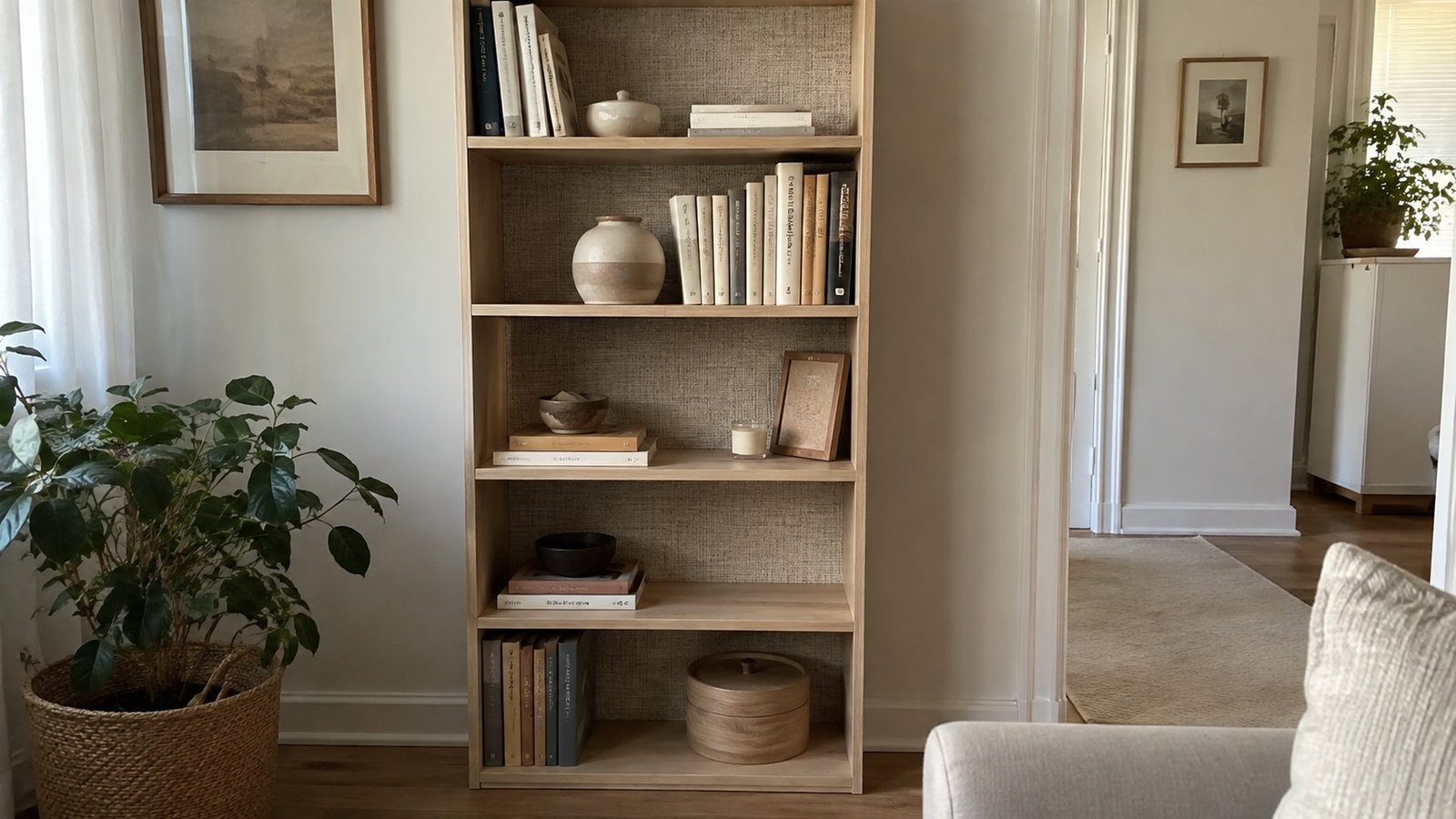
Keep peel-and-stick wallpaper on a small accent, not four walls. Cap the job at about 20-35 sq ft (1.9-3.3 m²): a Billy bookcase back about 30 × 79 in (76 × 201 cm) is roughly 15.5 sq ft (1.4 m²); one chimney breast about 48 × 96 in (122 × 244 cm) is about 32 sq ft (3.0 m²). Choose a quiet linen or plaster texture. Run a 48-hour closet test patch. Skip fresh paint under 30 days and heavy orange-peel. This is the calm renter recipe for peel and stick wallpaper.
Key takeaways
- Cap the accent at about 20-35 sq ft (1.9-3.3 m²). Never wrap a 10-ft bedroom.
- Best surfaces: Billy bookcase back (~15.5 sq ft / 1.4 m²), a desk wall strip, or one chimney breast (~32 sq ft / 3.0 m²).
- Prefer linen or plaster texture over loud botanicals in a small rental.
- Test patch in a closet for 48 hours. Skip paint cured less than 30 days. Skip heavy orange-peel texture.
- Removal: slow peel at about 45°, low heat if needed. Expect touch-up paint honesty. No zero-damage guarantee.
Where should peel and stick wallpaper go in a small rental?
Start with the surface you can walk away from. In a small rental, that is almost never a full feature wall that eats the whole room. It is a panel you already own, a strip behind a desk, or one chimney breast that already breaks the plan. The point of peel and stick wallpaper here is a calm texture note, not a renovation story for Instagram.
A Billy bookcase back is the friendliest starter. Typical width is about 30 in (76 cm) and height about 79 in (201 cm), which lands near 15.5 sq ft (1.4 m²). You can paper the back panel, slide the case into place, and the wallpaper never touches landlord drywall. When you move, the case leaves with you. That is the rental logic behind styling a shallow bookshelf: treat the case as furniture, not as a wall job.
A desk strip works when the desk sits tight to a blank wall. Paper a band about 36-48 in (91-122 cm) wide and about 48-60 in (122-152 cm) tall behind the monitor, not from baseboard to ceiling. That keeps the square footage near the low end of the 20-35 range and leaves the rest of the wall quiet. In a studio, the same strip can mark a work zone without a divider, the same idea as how you zone a studio without a divider.
One chimney breast is the upper cap. Measure width × height. A breast about 48 × 96 in (122 × 244 cm) is about 32 sq ft (3.0 m²), still inside the keep range. Paper only the breast face, not the returns on both sides, unless your math still stays under about 35 sq ft (3.3 m²). Four walls of a 10-ft (3 m) bedroom is the skip. That is a product roundup fantasy, not a small-space rental how-to.
How big should a peel-and-stick accent be?
The original measured keep: about 20-35 sq ft (1.9-3.3 m²). Below 20 sq ft (1.9 m²) the texture can still read if the panel is vertical and near eye level, like a Billy back. Above about 35 sq ft (3.3 m²) the room starts to feel wrapped, seams multiply, and removal risk climbs. Competitors sell rolls by the wall. You buy by the square foot you are willing to babysit at move-out.
Do the tape-measure math before you order. Width in inches × height in inches ÷ 144 = square feet. Width in cm × height in cm ÷ 10,000 = square meters. Write both numbers in your notes. Add about 10-15% for pattern match and mistakes on a textured linen, less if the pattern is nearly solid plaster. Do not order a whole-room kit “just in case.” Extra rolls become clutter in a small closet.
If two candidate surfaces both fit the cap, pick the one that is smoother, farther from steam, and easier to reach for a slow peel later. A bookcase back beats a kitchen splash strip for this URL. A kitchen backsplash is a short related note only: steam, grease, and heat are a different job. Keep this post on calm living or work accents.
Scale also protects calm. A small linen panel next to a grey sofa or a shallow shelf reads as texture, the same restraint that keeps a warm Scandinavian living room from looking busy in 200 square feet. A botanical jungle on three walls does the opposite of what makes a small room look bigger.
Which peel and stick wallpaper texture works in a calm rental?
Choose linen, plaster, soft grasscloth look, or a quiet tone-on-tone weave. Off-white, warm stone, pale sage, or light greige sit well with cream walls and oak. Skip oversized florals, neon geometrics, and high-contrast marble that photographs as a showroom. In a small rental the wallpaper should whisper. The furniture and light do the talking.
Matte finishes hide seams better than gloss in daylight. If the room is dark, a pale plaster texture still helps because it catches soft lamp light without glare, the same soft-layer idea behind how you decorate a dark apartment. Pair the panel with a 2700K lamp nearby so evening photos stay warm. Cool builder overheads make every seam look colder than it is. That lamp rule lives in the rental lighting stack.
Buy a sample or a short roll first when you can. Hold it against the wall in midday light and again at night under 2700K. If the sample shouts next to your sofa or bookshelf, it will shout louder at full height. Quiet texture is the keep. Loud pattern is the skip for this recipe.
How do you test peel and stick wallpaper before you commit?
Cut a test piece about 8 × 10 in (20 × 25 cm). Stick it inside a closet door, on the back of a pantry door, or on an inconspicuous spot of the exact surface you plan to use. Leave it for 48 hours. Check adhesion, edge lift, and whether paint or finish comes up when you peel a corner slowly at about 45°.
Forty-eight hours is the keep because overnight is not enough for apartment HVAC swings. Morning humidity and afternoon heat both matter. If the patch lifts on its own, the wall is too dusty, too textured, or the adhesive is wrong for that paint. If paint skins off with the patch, stop. You have a paint bond problem, not a wallpaper style problem. Plan for touch-up paint at move-out or pick a furniture surface instead.
Fresh paint is a hard skip for at least 30 days of cure. Manufacturer sheets vary, but the renter-safe rule here is simple: if the wall was painted this month, wait. Adhesive on soft paint is how deposits disappear. Dust the surface with a dry microfiber cloth before any test. Do not wash with oily cleaners that leave residue.
Can you put peel and stick wallpaper on orange-peel or textured walls?
Light orange-peel sometimes holds a thick linen vinyl if you burnish well and accept that seams may telegraph. Heavy orange-peel, knockdown, or popcorn is the skip for a clean calm look. Adhesive only kisses the peaks. Bubbles and edge lift follow. Competitors sometimes say “it works on texture.” Honest renter practice: if your palm feels a clear bumpy landscape, do not fight it with a full accent wall.
Workarounds that stay lease-friendly: paper a smooth Billy back, a flat board you lean or hang with renter hardware, or a smooth chimney breast if yours is actually flat. Do not skim-coat landlord walls unless your lease and deposit story can take it. This guide will not pretend heavy texture is a non-issue.
If you still try a mildly textured patch, use the 48-hour test on that exact wall. Peel slowly. Photograph the wall after. If you see paint loss or a chalky scuff, switch the project to furniture. A calm bookshelf back still gives you the texture hit without gambling four walls.
How do you install peel and stick wallpaper on a small accent?
Clean, dry, dust-free surface. Measure twice. Cut panels with a sharp blade and a straightedge. For a Billy back, remove the back panel if the case design allows, or paper it in place with the shelves emptied and the case pulled forward. For a wall strip, mark level lines with a pencil, not permanent ink.
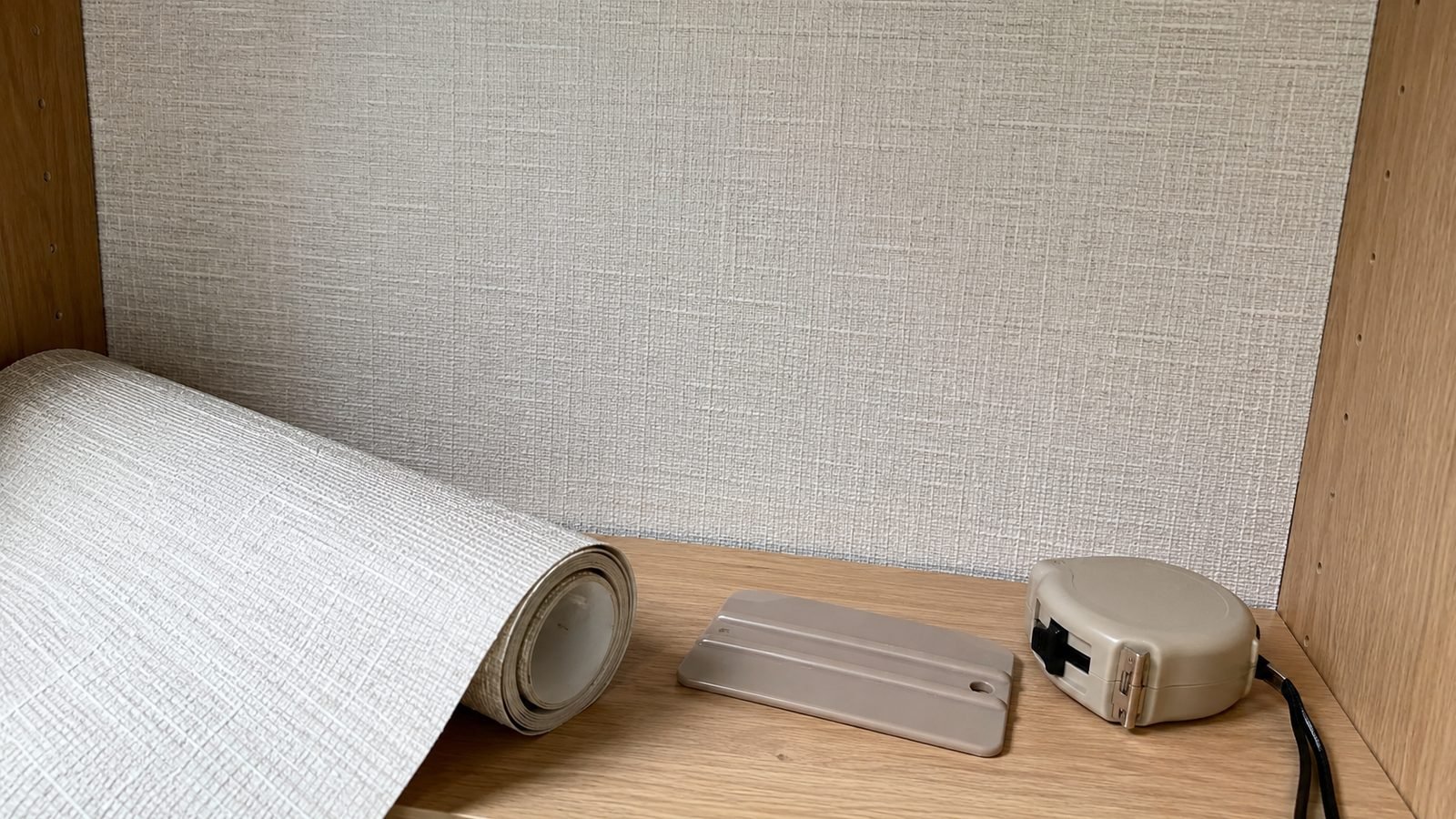
Peel a few inches of backing, align the top, and work downward. Use a plastic squeegee or a clean credit-card stand-in wrapped in a soft cloth. Push air toward the edges. Overlap seams only if the product instructions say to; many modern peel-and-stick rolls butt seam. Keep a soft cloth handy to wipe adhesive smudges. Work in daylight so you catch bubbles early.
On a chimney breast, start plumb at the center or at one edge, depending on pattern. Keep the returns unpapered if you are near the 35 sq ft (3.3 m²) cap. Stop at the mantel line if the mantel already frames the accent. Do not wrap into the ceiling plane. Ceiling returns are hard to remove cleanly and rarely improve a small room.
Tools to keep nearby: tape measure, sharp utility blade, plastic squeegee, soft cloth, step stool, and a hair dryer for later removal. Skip liquid primers that are not lease-approved. Skip permanent paste. The product is peel and stick for a reason.
How do you remove peel and stick wallpaper without wrecking paint?
Go slow. Lift a top corner and pull at about a 45° angle, close to the wall, not straight out like a bandage. Keep the pull steady. If adhesive fights you, warm a small area with a hair dryer on low, then continue. High heat can soften paint, so stay on low and keep the dryer moving.
Work in sections about 12-18 in (30-46 cm) wide. Pause if you see paint film lifting. Warm, slow down, and try a shallower angle. Some sheen paints release cleaner than flat paints. Older landlord paint may chalk. Budget a small tin of matching touch-up paint and a mini roller before move-out day. Honesty beats a zero-damage slogan.
Residue: wipe with a slightly damp microfiber cloth. Avoid harsh solvents on painted drywall unless the paint manufacturer allows them. On a Billy back, removal is usually kinder because you control the substrate. That is another reason furniture-first accents beat whole-room wraps in a rental.
Do not promise yourself or a landlord that peel and stick is always damage-free. Marketing pages say removable. Real walls vary. Your job is to reduce risk: small square footage, 48-hour test, cured paint, smooth surface, slow 45° peel, low heat, touch-up ready.
What about a kitchen backsplash?
Short note only. Peel and stick behind a stove sees grease, steam, and heat. That is a different product and maintenance story than a linen Billy back. If you try a splash strip, keep it away from open flame, clean it often, and accept a shorter lifespan. Do not treat this living-accent URL as a kitchen remodel guide. For calm living zones, stick to the 20-35 sq ft recipe above.
What should you keep, and what should you skip?
| Keep | Skip |
|---|---|
| Accent of about 20-35 sq ft (1.9-3.3 m²) | Four walls of a 10-ft bedroom |
| Billy back, desk strip, or one chimney breast | Whole-room kits as the first move |
| Linen or plaster texture in pale calm colors | Loud botanicals and high-contrast marble in a tiny room |
| 48-hour closet test patch | Installing the same day you open the roll |
| Paint cured 30+ days, smooth or light texture | Fresh paint under 30 days, heavy orange-peel |
| Slow 45° removal, low heat, touch-up paint ready | Zero-damage guarantees and fast yank peels |
Competitors love full-wall hero shots. A small rental needs circulation and quiet surfaces more than a wrap. Keep walk paths near 30-36 in (76-91 cm) when you pull furniture out to install, the same circulation-first habit as how you arrange furniture in a small living room. Put the case or desk back so the room still works for sitting and walking.
If your living room already leans warm grey textiles and soft light, a linen panel behind shelves supports that calm instead of fighting it. Pair with the sofa recipe from warming a grey rental sofa only after the wallpaper decision is measured and tested.
What does a weekend peel-and-stick accent look like?
Saturday morning: measure the candidate surface. Convert to square feet and square meters. Confirm it sits in the 20-35 sq ft (1.9-3.3 m²) band. Check paint age. If walls were painted less than 30 days ago, stop and switch to a Billy back you own. Buy or cut an 8 × 10 in (20 × 25 cm) test patch.
Saturday midday: stick the test patch in a closet or on the real substrate. Photograph it. Leave it alone for 48 hours. Use the rest of Saturday for ordinary life. Do not install the full accent yet.
Monday evening (after 48 hours): peel the test slowly at 45°. If the surface looks honest and adhesion was solid, clean the real area, cut panels, and install with a squeegee in daylight. Live with it for a night under 2700K lamps. If a bubble appears, work it to the edge. If a seam lifts, warm gently and burnish.
That is the whole method: measure the cap, pick a small calm surface, choose quiet texture, test 48 hours, install once, plan a slow removal. Peel and stick wallpaper earns its keep in a rental when it stays small enough to reverse.
FAQ
Does peel-and-stick wallpaper damage walls?
It can. Risk drops when you stick to smooth, fully cured paint, keep the accent near 20-35 sq ft (1.9-3.3 m²), run a 48-hour test patch, and remove slowly at about 45° with low heat if needed. Expect possible touch-up paint. There is no honest zero-damage guarantee on every landlord wall.
Can you put peel and stick wallpaper on textured or orange-peel walls?
Light orange-peel is a maybe after a 48-hour test. Heavy orange-peel, knockdown, or popcorn is a skip for a clean calm accent. Prefer a smooth Billy bookcase back or a flat board so adhesive contacts a full surface instead of only the texture peaks.
How do you remove peel and stick wallpaper without wrecking paint?
Lift a corner and pull slowly at about 45°, close to the wall. Use a hair dryer on low for stubborn adhesive. Work in 12-18 in (30-46 cm) sections. Keep touch-up paint ready. Do not yank straight out. Do not blast high heat on soft paint.
How many square feet should a small rental peel-and-stick accent be?
About 20-35 sq ft (1.9-3.3 m²). A Billy back near 30 × 79 in (76 × 201 cm) is about 15.5 sq ft (1.4 m²). One chimney breast near 48 × 96 in (122 × 244 cm) is about 32 sq ft (3.0 m²). Skip four walls of a 10-ft bedroom.
How long should a closet test patch sit before you commit?
Leave an 8 × 10 in (20 × 25 cm) patch for 48 hours on the same surface type. Also skip walls painted less than 30 days ago. Overnight tests miss HVAC humidity swings. If paint lifts with the patch, switch to a furniture surface.
Related: style a shallow bookshelf · what makes a small room look bigger · decorate a dark apartment · warm Scandinavian living room · warm a grey rental sofa · the rental lighting stack · circulation-first furniture layout · zone a studio without a divider