
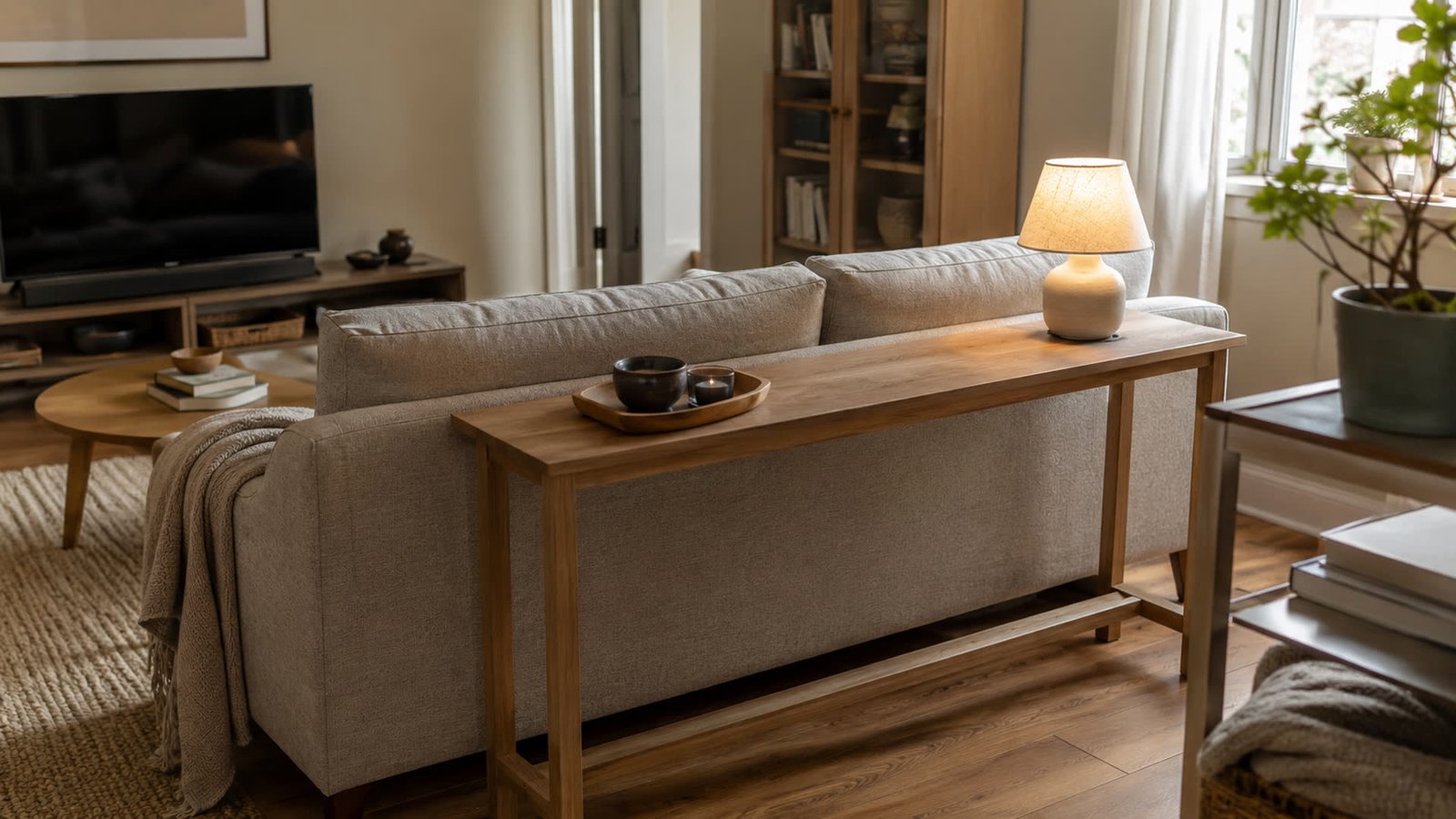
A console behind a small sofa works when the top is only 12 in (30 cm) deep, not a 16-18 in (41-46 cm) foyer piece. Keep 30 in (76 cm) of walk behind the console if the lane is a pass-through, or 18 in (46 cm) if it is a dead end. Style with a lamp at one end, one tray, and an empty third of the top. Skip wall-mounted floating consoles that need anchors. Console height should sit near the sofa back or arm so the lamp meets eye line without a wall sconce.
Key takeaways
- Console depth cap: 12 in (30 cm). A 16-18 in (41-46 cm) foyer console eats the walk behind a small sofa.
- Walk behind the console: 30 in (76 cm) if it is a pass-through; 18 in (46 cm) if it is a dead end. Tape it before you buy.
- Height: match sofa back or arm height so a lamp sits near eye line. Skip a wall sconce and skip wall-mounted floating consoles that need anchors.
- Surface recipe: lamp at one end + one tray + empty third (same 40% empty spirit as a small coffee table). No décor forest.
- Cable drop from the TV can hide down the console back. Legs and felt pads, not wall anchors. Photograph floors at move-in.
When does a 12 in console beat a 16-18 in foyer piece behind a sofa?
It beats a deeper console when the sofa floats and the lane behind it is already thin. A 16-18 in (41-46 cm) foyer console looks fine in an entry that has 36 in (91 cm) of clear walk. Behind a small sofa it steals the only path to a window, a balcony, or the second bedroom. The 12 in (30 cm) depth is the rental case. It holds a lamp base, a tray, and a coaster stack. It does not hold a décor forest. That is the point.
Tape both depths on the floor. Mark a 12 in strip and an 18 in strip behind the sofa back. Sit. Walk the leftover. If the 18 in strip leaves less than 30 in (76 cm) on a pass-through, the deep console is the skip. If the lane is a dead end against a window or a radiator, you still prefer 12 in so the dead-end keep of 18 in (46 cm) of walk stays honest. A deeper top plus an 18 in dead end feels like a hip check every time you reach for the curtains.
Length should roughly match the sofa, or sit 4-8 in (10-20 cm) shorter so the sofa arms still read from the side. Do not buy a 72 in (183 cm) console for a 60 in (152 cm) loveseat. The overhang looks like a hotel lobby and forces the walk to squeeze at the ends. This is the same honesty as how you arrange furniture in a small living room: measure the leftover first, then shop.
How much walk space do you need behind a sofa console?
Keep 30 in (76 cm) of clear walk behind the console if people pass through to another room, a balcony, or a closet. That number is the remaining aisle after the console depth, not the distance from sofa back to wall. From sofa back to wall on a pass-through you often need about 42 in (107 cm): 12 in of console plus 30 in of walk. If your tape shows only 36 in (91 cm) total, a 12 in console leaves 24 in (61 cm). Call that a squeeze, not a walk. Either skip the console, or float the sofa farther into the room and recheck the front gap to the coffee table.
If the lane is a dead end (window, radiator, or blank wall with nowhere to go), 18 in (46 cm) of walk behind the console is the keep. You still need room to dust, open a drawer, and reach the sill. Twelve inches of leftover is not enough to stand and wipe. Eighteen inches is a real service gap. Tape both options. Walk them with a laundry basket. The pass-through number and the dead-end number are different on purpose. Do not pretend 18 in is a hallway.
In a studio, the console should not block the sleep-to-bath path. Zone with the sofa back and the rug edge, not a screen. If the only 30 in (76 cm) lane is already the bath path, the console does not go there. Move the sofa so the console sits on a quieter wall, or skip the console and use a slim floor lamp beside the arm. The room still has to work with a TV, and the walk still has to feel like air you can move through, the same habit that makes a small room look bigger.
How tall should a console be relative to the sofa back?
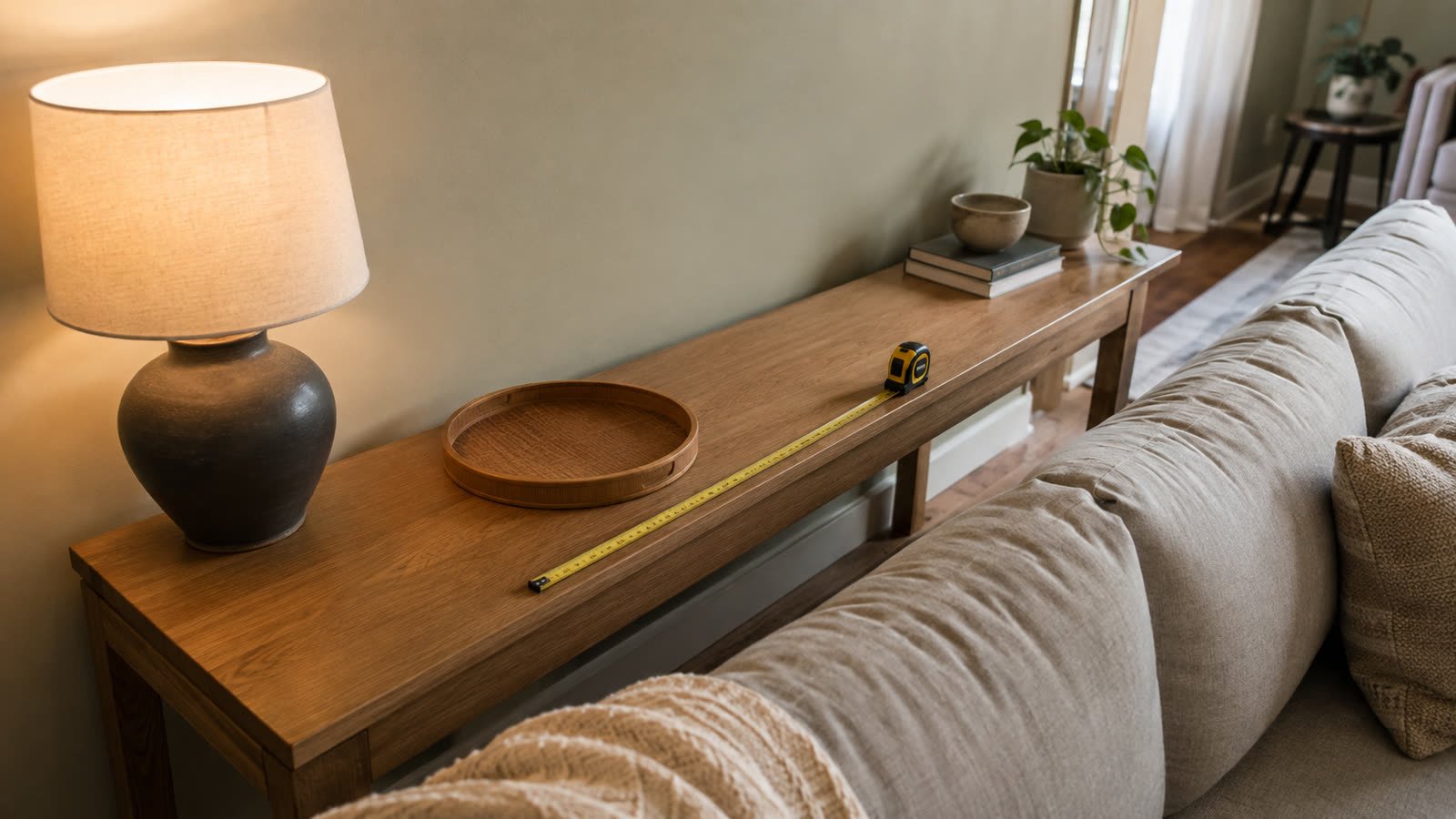
Match the sofa back or the arm height, whichever sits higher on your piece. Most small rental sofas land around 30-34 in (76-86 cm) at the back. A console in that band puts a lamp shade near seated eye line and standing eye line without a wall sconce. If the console is 6 in (15 cm) shorter than the sofa back, the lamp base sinks and the shade lights the cushions, not faces. If the console is 6 in taller, you get a hotel ledge that crowds the walk and makes the sofa look swallowed.
Measure the sofa from floor to the top of the back cushion, not to the seat. Write both inches and centimeters. Shop for a console whose top lands within about 2 in (5 cm) of that number. Open-leg consoles feel lighter than solid plinth bases in a small room. A plinth base also hides less cable drop because the back is a solid panel that wants to sit flush. Legs leave a gap you can use.
Skip the urge to add a wall sconce above the console. Hardwired sconces are landlord work. Plug-in sconces still want anchors or adhesive that fails on textured paint. The console lamp is the light. Keep it in the rental lighting stack: 2700K, plug-in, shade at face height. One lamp is enough for this job. A second lamp on the other end usually starts a décor forest.
How do you style a console behind a sofa without a décor forest?
Use the same empty-surface spirit as how you style a small coffee table. On a coffee table the rule is about 40% empty for a mug and a laptop. On a 12 in (30 cm) console the top is already narrow, so think in thirds along the length: lamp at one end, tray in the middle third, empty third at the other end. The empty third is for a coaster, a phone, or nothing. It is not leftover. It is the use zone.
Lamp first. Choose a base that fits the 12 in depth with at least 1 in (2.5 cm) of margin so the shade does not hang over the sofa back and snag hair. A cylindrical or tapered base about 4-6 in (10-15 cm) across is safer than a wide urn. Shade at about 14-16 in (36-41 cm) diameter max on this depth. Bulb 2700K. Cord drops toward the wall or down a rear leg, not across the walk.
Tray second. A shallow wood or metal tray about 10-12 in (25-30 cm) long and no wider than 8-9 in (20-23 cm) holds remotes, a candle, or keys that used to live on the coffee table. One low object in the tray is enough. Skip stacked books that eat the empty third. Skip a vase with a wide bouquet that shades the lamp and catches sleeves. If you want a stem, use one cutting in a slim bottle no taller than about 10 in (25 cm), still inside the tray footprint.
Empty third last. Leave it. If mail lands there, move mail to the tray or off the console in the evening reset. A décor forest is what happens when every inch gets an object. A calm console is what happens when a third of the length stays blank and you can still set a glass down without rearranging.
How do you hide a TV cable drop, and why skip a wall-mounted floating console?
If the TV sits on a stand or a low media unit in front of the sofa sightline, spare HDMI and power cords often want a path that is not a black stripe on the wall. When the sofa floats, a console behind it can catch a discreet cable drop down the console back, then along a rear leg to an outlet. Raceway, fabric cord covers, and outlet placement still follow the rental wire guide in how you hide TV wires in a rental. The console is a shield, not a hardwired chase. Do not drill the wall for in-wall cable if the lease forbids it.
Skip wall-mounted floating consoles. They need anchors, toggles, or French cleats. Those are deposit fights on plaster and on hollow rental walls. They also fix the height forever, so you cannot nudge the sofa without leaving holes. A freestanding 12 in console on felt pads moves with you. Photograph the floor and the pads at move-in. Lift, do not drag, on vinyl and wood.
If your TV layout already uses a wall mount and the cords are clean, you may not need the console as a cable shield at all. Then the console is only for lamp, tray, and empty third. That is still a valid job. Just do not add a floating shelf above it for more objects. More objects is how the forest starts. Keep art on the sofa wall only if you can hang without nails using the same calm rules as hanging art in a rental without nails, and keep that art off the console top.
What should you keep, and what should you skip?
| Keep | Skip |
|---|---|
| Console depth about 12 in (30 cm) | A 16-18 in (41-46 cm) foyer console that eats the walk |
| 30 in (76 cm) walk on a pass-through; 18 in (46 cm) on a dead end | Calling a 12-18 in hip-check a hallway; blocking the studio bath path |
| Height near sofa back or arm so the lamp meets eye line | A console 6 in shorter or taller than the sofa back; a wall sconce for the same job |
| Lamp at one end + one tray + empty third | Décor forest, stacked books across the full length, two lamps fighting for shade space |
| Freestanding legs, felt pads, cord drop down the back | Wall-mounted floating console, anchors, French cleats, in-wall cable without lease OK |
| Length near sofa length, or 4-8 in (10-20 cm) shorter | A lobby-length console that overhangs a loveseat and pinches the ends |
| 2700K plug-in lamp on the console | Hardwired sconce, adhesive light strip peeling off textured paint |
A small rental needs one honest job behind the sofa: a 12 in top, a measured walk, a lamp you can unplug, and a third of the surface left empty. Photograph pads and floor at move-in. There is no honest zero-damage promise on every finish.
What does a weekend console setup look like?
Saturday morning: measure the leftover behind the sofa. Write distance from sofa back to wall, in inches and centimeters. Decide if the lane is a pass-through or a dead end. Mark a 12 in (30 cm) deep rectangle the length of the sofa, or 4-8 in (10-20 cm) shorter. On a pass-through, tape 30 in (76 cm) of walk behind that rectangle. On a dead end, tape 18 in (46 cm). Walk it with a bag. Sit on the sofa. If a door, radiator, or TV pass fails, stop. The console does not go here. Float the sofa, recheck the coffee-table gap and rug size, then shop.
Saturday midday: if the tape works, bring in the console. Confirm depth 12 in (30 cm) with the tape on the top, not from memory. Confirm height within about 2 in (5 cm) of the sofa back. Add felt pads before it lands. Lift into place. Set one 2700K plug-in lamp at one end with shade clearance off the sofa back. Park one shallow tray in the middle third. Leave the far third empty. Drop any TV cord along the console back toward an outlet using the rental wire method, not new wall holes.
Saturday evening: live-test. Walk the pass-through with laundry. Stand in the dead-end gap and wipe the sill if that is your case. Set a glass in the empty third. If the glass does not fit without moving the tray, the tray is too big. Swap it. Sunday daylight: photograph from the doorway. If you see a wall-mounted slab, a décor forest, or a walk you would not trust with a suitcase, you have left the recipe. Clear the empty third. Restore the walk. That is the method: 12 in depth, 30 in pass-through or 18 in dead-end walk, height near the sofa back, lamp plus tray plus empty third, no wall mount.
Keep color quiet. Match wood tone to oak or walnut already in the room, the same restraint as a warm-grey rental sofa. Soft daylight and one lamp are enough; skip a second vignette behind the legs.
FAQ
Can You Put a Console Table Behind a Sofa?
Yes, when the sofa floats and the leftover depth supports a 12 in (30 cm) console plus a real walk. Keep 30 in (76 cm) behind the console on a pass-through, or 18 in (46 cm) on a dead end. If the tape never yields those numbers, skip the console or float the sofa farther forward and recheck the coffee-table gap. A console behind a sofa that sits hard against a wall has no job and no walk.
What’s the Perfect Height for a Console Table Behind Your Couch?
Match the sofa back or arm height, usually about 30-34 in (76-86 cm) on a small rental sofa. Stay within about 2 in (5 cm) of that number so a lamp shade sits near eye line without a wall sconce. A console much shorter sinks the lamp into the cushions. A console much taller crowds the walk and makes the sofa look swallowed. Measure floor to back cushion, then shop.
How to Style a Console Table Behind a Sofa
Use a lamp at one end, one shallow tray in the middle third, and leave an empty third of the length clear. That is the same empty-surface spirit as the 40% empty coffee-table rule, adapted to a 12 in (30 cm) depth. Keep objects inside the tray footprint. Skip stacked books across the full top and skip a second lamp. One 2700K plug-in bulb is enough. Reset mail off the empty third every evening.
How much walk space behind a sofa console in inches and centimeters (pass-through 30 in vs dead-end 18 in)?
On a pass-through, keep 30 in (76 cm) of clear walk behind the console. On a dead end, keep 18 in (46 cm) so you can stand, dust, and reach a sill. Measure the aisle after the console depth, not from the sofa back alone. With a 12 in (30 cm) console, a pass-through often needs about 42 in (107 cm) from sofa back to wall. Tape it and walk it with a bag before you buy.
Should renters use a wall-mounted floating console behind the sofa?
No. Skip wall-mounted floating consoles. They need anchors, toggles, or cleats, which are deposit risks on rental walls, and they lock the height so you cannot nudge the sofa without holes. Use a freestanding 12 in (30 cm) console on felt pads. Hide a TV cable drop down the console back if needed, without in-wall drilling unless the lease clearly allows it. Take the whole piece with you at move-out.
Related: circulation-first furniture layout · style a small coffee table · hide TV wires in a rental · small living room with a TV · rental lighting stack · warm-grey rental sofa · rug size for a small living room · what makes a small room look bigger · hang art without nails