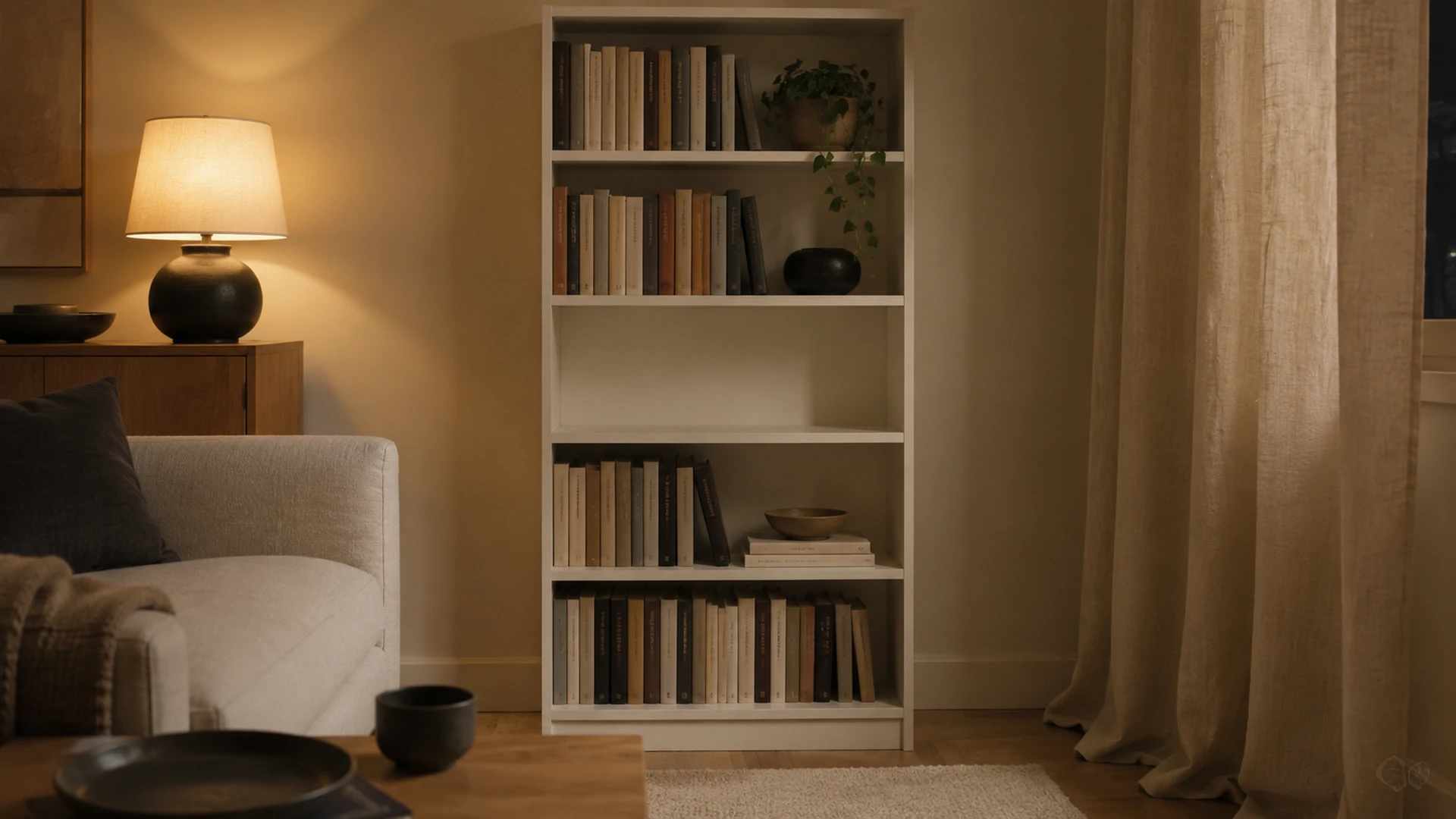
To style a bookshelf that is only 11 in (28 cm) deep, use one formula per cubby and leave one cubby empty on purpose. Vertical books are texture, not a library flex. A stack is two books, maybe three, plus one object. Ugly spines get two linen wraps, max, not a row of fake titles. The gift-shop look is too many objects, too many colors, and no air. Treat each cubby as a small surface, the same way you style a small coffee table.
Key takeaways
- One formula per cubby. Vertical books, or a stack of two plus one object, or one object alone. Never four objects in one hole.
- One empty cubby is mandatory. A thin gap is not air. A full case is a store display.
- Depth is 11 in (28 cm) on a standard Billy. Objects deeper than 10 in (25 cm) hang over the lip. Bowls and ceramics stay 4–6 in (10–15 cm) across.
- Books stay mostly vertical. A horizontal stack is a platform, not a wall of pancakes. Two linen-wrapped books max. No fake-book sets.
- Light the case at 2700K, a lamp within 24–36 in (61–91 cm). A 4000K globe turns the shelves into a grid.
How do you style a bookshelf without it looking like a gift shop?
A gift shop is a grid of objects with no rest. Every cubby is full. Every spine is a different color. A candle, a frame, a succulent, a clock, and a bowl share one 13 in (33 cm) hole. The eye cannot stop. Packed shelves photograph as “enough stuff.” In a small rental they read as noise.
Start from the empty case, not from the objects you own. A standard tall Billy is about 31.5 in (80 cm) wide, 11 in (28 cm) deep, and 79.5 in (202 cm) high, with cubbies around 13 in (33 cm) high once the pins are in. Count the holes. Eight cubbies means you style seven and leave one blank. Five means you style four. The empty one is the pause that makes the rest readable.
Edit before you style. Pull everything off. Keep books you read, or that have quiet spines (oat, linen, charcoal, clay, forest). Box the neon paperbacks, the conference swag, and the dusty frames. You can add one thing back. You cannot hide a crowded cubby with a plant. The same edit that makes a small room look bigger applies: mass and outlines shrink a wall. Air enlarges it.
What is the one-formula-per-cubby rule?
Each cubby gets one job. Not a vignette with five props. Three formulas cover a shallow case:
| Formula | What goes in | Leave empty |
|---|---|---|
| Vertical books | A run of books, spines aligned, about 60–75% of the cubby width. | 2–4 in (5–10 cm) of air at one end, or a single bookend. |
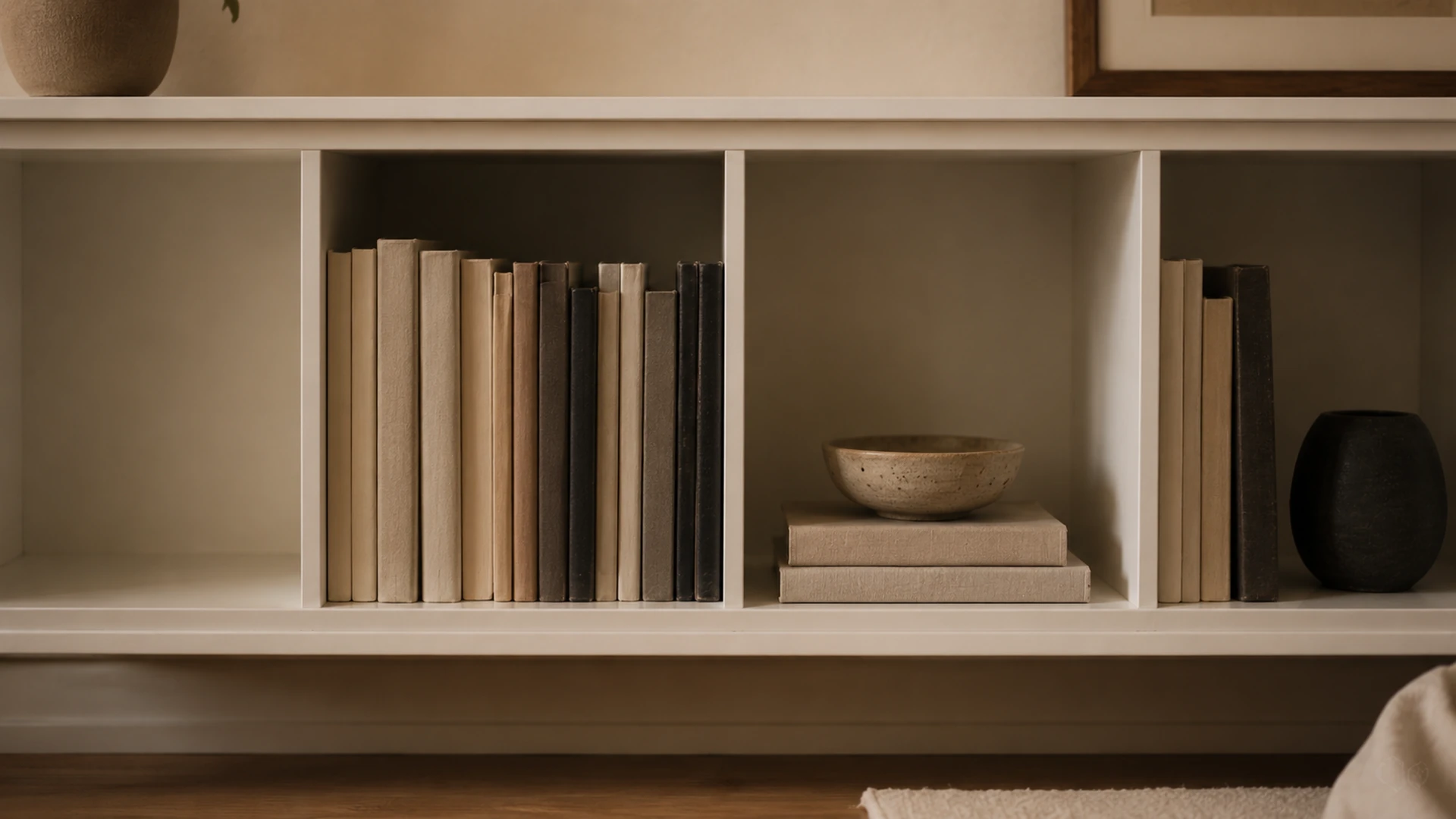
| Stack plus one | Two books horizontal, sometimes three. One object on top: bowl, ceramic, small plant. | The rest of the cubby. No second object beside the stack. |
| Object alone | One ceramic, one leaned print, or one plant in a quiet pot. | Most of the cubby. This is a rest, not a display. |
Alternate the three as you move down the case. Two vertical-book cubbies in a row is fine. Three stack-plus-one cubbies in a column is a gift shop again. Put the empty cubby where the eye hits first, often the second row from the top, slightly off center. Do not hide it on the bottom behind the sofa arm. If you cannot see the air, it is not doing the job.
Measure the object against the hole. A cubby 13 in (33 cm) high and about 14 in (36 cm) wide can take a stack of two books about 1.5–2 in (4–5 cm) each plus a bowl about 4–5 in (10–13 cm) tall. A 10 in (25 cm) vase will hit the shelf above. That is how “styled” turns into cramped.
Why must one cubby stay empty?
Negative space is the only styling move that costs nothing and works on every case. A packed 31.5 in (80 cm) Billy on an 11 ft (335 cm) wall becomes the loudest object in the room. One empty cubby breaks the grid. The case reads as furniture again, not as a shop window.
Leave a whole cubby empty, not a thin gap. A 1 in (2.5 cm) sliver next to a jammed row of paperbacks is not air. You want a hole the eye can name. If you have two Billys side by side (about 63 in / 160 cm of wall), leave one empty cubby in each case, not two empties stacked in one and a packed neighbor.
People refill the empty cubby in a week. Nothing lives there except dusting. Extra storage is a lidded basket about 10 × 12 in (25 × 30 cm) on the bottom row, not more open objects. Shoes and keys live on the 24-inch entry wall.
How do you style an 11-inch-deep IKEA Billy?
The 11 in (28 cm) depth is the rental reality. Most “bookshelf styling” photos are shot on 14–16 in (36–41 cm) built-ins. A dinner plate, a 12 in (30 cm) sculpture, or a stacked record crate will hang over a Billy lip. Measure depth first, the same way you arrange a small living room from circulation before you pick the sofa.
Rules that fit 11 in (28 cm):
- Books sit flush or 0.25 in (0.6 cm) back from the front edge. Do not shove them to the back wall. A 0.5–1 in (1–2.5 cm) shadow at the back is fine. A 3 in (8 cm) cave behind short paperbacks looks unfinished.
- Objects max out around 10 in (25 cm) deep. Bowls and ceramics 4–6 in (10–15 cm) across. Frames leaned at a shallow angle, about 8 × 10 in (20 × 25 cm) or 5 × 7 in (13 × 18 cm), not 16 × 20 in (41 × 51 cm).
- Plants: one small trailer or upright in a pot under 5 in (13 cm) wide. A 10 in (25 cm) fiddle leaf is a floor plant.
- No picture ledge in front of the books. You do not have the depth. A second layer is how the gift shop starts.
A 9.5 in (24 cm) cube or a 7.9 in (20 cm) Kallax uses the same math with a tighter object list: one object, or a handful of vertical books. Anchor a tall Billy to a stud, or use a strap the landlord accepts. Heaviest books on the bottom two rows.
Should books go vertical or horizontal?
Mostly vertical. A run of vertical spines is one texture, like linen on a window. Horizontal books are a platform for one object, or a way to park two oversize titles. A cubby of only horizontal stacks looks like a warehouse. A cubby of only vertical books with no air looks like a library dump.
On a tall 31.5 in (80 cm) Billy, aim for three or four vertical-book cubbies (each with 2–4 in / 5–10 cm of air), one or two stack-plus-one cubbies, one single-object cubby, one empty cubby, and an optional closed box on the bottom. Sort by tone, not rainbow: oat and linen, then charcoal, then a small clay run. Height can vary. Align spines to the same front plane.
Do not sort by catalog number unless this is a working library and the room can take the noise. In a small living room that also holds a TV, the case is a calm wall. Keep the TV wall itself quiet with a layout that still feels like a sitting room, and get the cable drop off the plaster with a renter path for TV wires.
What objects actually work on a shallow shelf?
Fewer than you think. If you cannot name why a piece is there (you use it, you like the material, it is the one dark stop), it is merch.
What works at 11 in (28 cm): a ceramic bowl, 4–6 in (10–15 cm) across, oatmeal or charcoal, with one stem if you want height; one dark object for weight, the same stop as the warm Scandinavian sequence; one small plant, pot under 5 in (13 cm), watered in the sink; one leaned print, no collage of four frames. A tray belongs on top of the case. A 10 × 14 in (25 × 36 cm) tray can hold a 14–18 in (36–46 cm) lamp if the cord drops along the side, not across the walk.
What does not work: a clock in every other cubby, a row of candles (wax on particleboard), travel miniatures, open baskets of remotes, and anything with a logo on the front. If remotes have to live here, use one closed box on the bottom row. The coffee table already has a 40% empty rule. Do not move the clutter onto the shelf.
How do you hide ugly spines without fake books?
Do not buy dummy books with Latin on the spine. They read as a set from six feet away, and they waste a cubby you could use for real books. Two linen wraps is the cap.
Wrap only the loudest two: a neon paperback, a glossy title, a damaged jacket. Use oatmeal linen or quiet paper, folded like a dust jacket, taped inside, title off the spine. More than two wraps looks like a prop house. Better: turn two or three books spine-in for a page-block stripe; park remaining loud paperbacks in a closed bottom box; or group leftover loud spines in one cubby as a single color block.
Do not print fake titles. Do not buy decorator books by the foot. If you do not have enough quiet books, you do not have a styling problem. You have an empty-cubby opportunity. Fill with air, one ceramic, and the books you actually own.
How do you style a full wall of Billys in a small rental?
Two or three cases become architecture. A single 31.5 in (80 cm) Billy on an 11 ft (335 cm) wall is furniture. Two are 63 in (160 cm). Three are 94.5 in (240 cm). Leave 8–12 in (20–30 cm) from the case to a door casing, and a walkway of 18–24 in (46–61 cm) in front. If the sofa back faces the case, an 11 in (28 cm) case plus a 32–36 in (81–91 cm) sofa still needs that walk. In a studio, the case back can help zone without a room divider only if the rug still holds the sofa’s front legs, per the front-legs-on rug rule.
Style a wall of cases as one composition. One empty cubby per case. Repeat the same oat and charcoal spine family across all of them. Closed boxes only on the bottom row, same height. Do not checkerboard empties in a perfect pattern. Slightly off-center reads like a room.
Skip glass doors unless the room is truly dusty. Glass doubles a 4000K globe. Light the wall with a floor lamp 48–65 in (122–165 cm) to one side, 2700K, or a plug-in picture light with the cord down the side. No RGB shelf LEDs. Run the rest of the room on the rental lighting stack. If this wall also has to close as work at 6 p.m., keep the monitor off the open shelves, the same filter as office trends that belong in a small home.
What should you skip on a rental bookshelf?
Skip the merch layer, fake plants in every other cubby, a gallery of 4 × 6 in (10 × 15 cm) photos, and collectible boxes face-out. One quiet linen peel-and-stick on a single cubby back can work. A botanical in all eight is a booth at a fair.
Skip stacking a second set of cubes on a 79.5 in (202 cm) Billy under an 8 ft (244 cm) ceiling. You have about 16.5 in (42 cm) of air up there. A second box looks jammed. One lamp on top is enough.
Skip styling the case before the window and the floor are right. High and wide curtains and a correctly sized rug do more for the room than a perfect shelf. Hang the rod with the high-and-wide rental method first. Then come back to the cubbies. A styled case under a rod on the trim still photographs as a small box.
What does a 31.5-inch Billy look like after the formula?
Take a tall white Billy, 31.5 × 11 × 79.5 in (80 × 28 × 202 cm), seven cubbies plus a slightly taller bottom bay, in an 11 × 12 ft (335 × 366 cm) room with a sofa on legs and an oat rug. Before: books double-stacked, a candle in every other hole, three frames, two fake plants, no empty cubby.
After, top to bottom: (1) vertical oat books, 70% width, 3 in (8 cm) of air; (2) empty, the pause above seated eye level; (3) charcoal and forest books, air on the left; (4) two horizontal books and a 5 in (13 cm) oatmeal bowl; (5) mixed quiet spines, 2 in (5 cm) of air; (6) one 8 × 10 in (20 × 25 cm) print leaned with two books as a weight; (7) two oatmeal linen boxes, about 10 × 12 × 7 in (25 × 30 × 18 cm), neon paperbacks and remotes inside, lids on.
On top: one charcoal ceramic lamp, about 16 in (41 cm) high, 2700K, cord down the side to the outlet. No runner of objects. From the sofa you see air, quiet spines, one bowl, one dark lamp. Sunday reset is about 15 minutes. Mail goes back to the entry tray.
That is how you style a bookshelf in a small rental. Depth is 11 in (28 cm). One job per cubby. One cubby empty. Two wraps, not a fake library.
FAQ
How do you style a bookshelf that is only 11 inches deep?
Use objects under 10 in (25 cm) deep, bowls 4–6 in (10–15 cm) across, and books flush to the front plane. One formula per cubby: vertical books, or a stack of two plus one object, or one object alone. Leave one cubby empty. Skip a second layer of frames in front of the books. You do not have the depth.
How many decorative objects should you put on a bookshelf?
Fewer than a typical styling photo. On a tall 31.5 in (80 cm) Billy, two or three objects plus one plant is plenty, plus books. Every cubby does not get an object. If you cannot name the job of a piece, it is merch. Closed boxes on the bottom row count as storage, not as decor.
Should you leave empty space on a bookshelf?
Yes. One whole cubby empty is the rule, not a thin gap. Air is what keeps a shallow case from reading as a gift shop. If you have two cases, leave one empty cubby in each. Do not hide the empty cubby behind the sofa arm.
Is it better to arrange books vertically or horizontally?
Mostly vertically, as one quiet texture. Use a horizontal stack of two or three books only as a platform for one object. A cubby of only horizontal stacks looks like storage. A cubby of vertical books with 2–4 in (5–10 cm) of air looks like a room.
How do you hide ugly book spines?
Wrap at most two loud titles in linen. Turn two or three books spine-in for a page-block stripe. Park the rest in a closed bottom box, or group remaining loud spines in one cubby as a single color block. Do not buy fake decorator books. Do not wrap a whole case.
Related: style a small coffee table · warm Scandinavian living room sequence · the rental lighting stack · circulation-first furniture layout · what makes a small room look bigger · hang curtains high and wide · rug size, front legs on · small living room with a TV · hide TV wires in a rental · zone a studio without a divider · small entryway, no closet · office design trends 2026, small home