
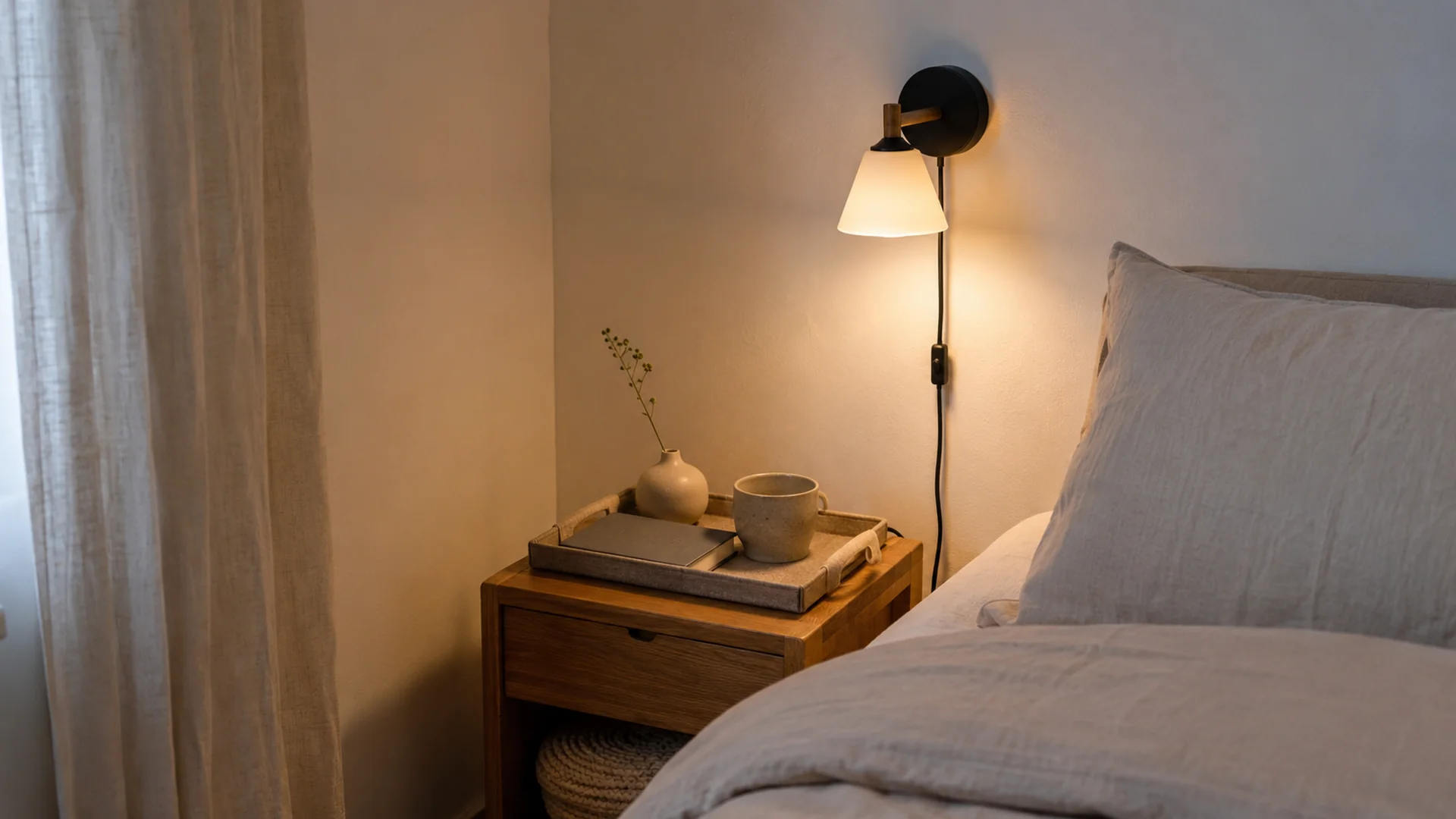
The calm answer for how to style a nightstand that is only about 16 in (41 cm) wide: move the lamp off the table. A plug-in sconce (or wall lamp) frees the top for a tray, one book, and one object. Route the charging cord neatly. Matching pairs are optional. Identical heights are not required. This is the calm recipe for tiny rental nightstands, floating shelves used as nightstands, and one-side setups in a studio.
Key takeaways
- If the nightstand is about 16 in (41 cm) wide or less, do not park a table lamp on it. Use a plug-in sconce instead.
- Style formula: tray + book + one object (optional small plant). Leave about 30–40% of the top empty.
- Warm light at 2700K. Hang the sconce so the shade center sits near seated or propped-up eye level, often 48–54 in (122–137 cm) from the floor.
- Route cords down the back leg or along the baseboard. One phone charger on the nightstand is enough. Hide the brick.
- Matching pairs are optional. One side only is fine in a studio. A floating shelf can stand in for a nightstand when the floor is tight.
How do you measure a tiny nightstand before you style it?
Start with a tape measure, not a shopping cart. Write down width, depth, and height. Most “tiny” rental nightstands land near 12–18 in (30–46 cm) wide and 12–16 in (30–41 cm) deep. Height should sit close to the top of your mattress, usually within about 2–4 in (5–10 cm) of mattress height so you can reach a glass of water without a stretch.
Also measure the gap beside the bed. Leave a walk of about 18–24 in (46–61 cm) if that side is a path to a closet or bathroom. If the gap is under 18 in (46 cm), a deep chest will bruise shins and make the room feel jammed. Prefer a slim footprint, or a wall-mounted floating shelf that frees the floor.
Clearance above the top matters too. If a shelf or window sill sits less than 18 in (46 cm) above the nightstand, a tall lamp will look crushed. That is another vote for moving light to the wall. Measure once. Style once. You will skip the lamp that never fit.
| What to measure | Typical tiny range | Why it matters |
|---|---|---|
| Width | 12–18 in (30–46 cm) | Under ~16 in (41 cm): lamp off the table |
| Depth | 12–16 in (30–41 cm) | Keeps a glass and book without overhang |
| Height vs mattress | Within 2–4 in (5–10 cm) | Reach without sitting up hard |
| Side walkway | 18–24 in (46–61 cm) | Path stays usable in a small room |
| Sconce center height | About 48–54 in (122–137 cm) | Warm pool at propped-up eye level |
When should the lamp leave the nightstand?
When width is about 16 in (41 cm) or less, a standard table lamp fights the surface. A shade that is 10–14 in (25–36 cm) across plus a base leaves almost no room for a book, a glass, or your phone. The top becomes a lamp stand with clutter around the edges. That is the opposite of calm.
Move the lamp when any of these are true: the shade overhangs the front edge, you knock the lamp when you reach for water, the cord snakes across the top, or the only way to fit a lamp is a mini novelty that still looks busy. A plug-in sconce solves all four without hardwiring. It is the same renter-friendly idea as the rest of a rental lighting stack: warm pools at useful heights, no new circuits in the wall.
Keep the bulb at 2700K warm white. Cool 4000K bedside light wakes the room at the wrong hour. Prefer a fabric or paper shade that softens glare when you sit up to read. Aim for a dimmable bulb or a cord dimmer / smart plug so 10 p.m. can go soft without flipping the builder overhead.
How do you hang a plug-in sconce beside a tiny nightstand?
Pick a plug-in or hardwire-look wall lamp with a fabric-covered cord you can run down the wall. Mount with a removable hook, adhesive strip rated for the weight, or a small screw into a stud if the lease allows and you will patch later. Center the shade near propped-up eye level, often 48–54 in (122–137 cm) from the floor. Horizontal placement is usually 6–12 in (15–30 cm) out from the headboard edge, or centered above the nightstand if the wall is narrow.
Leave about 8–12 in (20–30 cm) of clear wall between the bottom of the shade and the nightstand top so the light pools on the tray, not into your eyes when you lie flat. If the outlet is behind the bed, run the cord down the wall, then along the baseboard to the outlet. Paintable cord covers or a thin raceway keep the line quiet. The goal is one vertical line, not a zigzag across pillows.
In a dark bedroom, this wall light becomes your evening pool. Pair it with the same warm temperature you use elsewhere so the room does not flip from cozy living room to clinical sleep cave. Soft layers help a small room feel clearer, the same logic behind what makes a small room look bigger: less visual noise, better light placement.
What is the tray formula for a tiny nightstand?
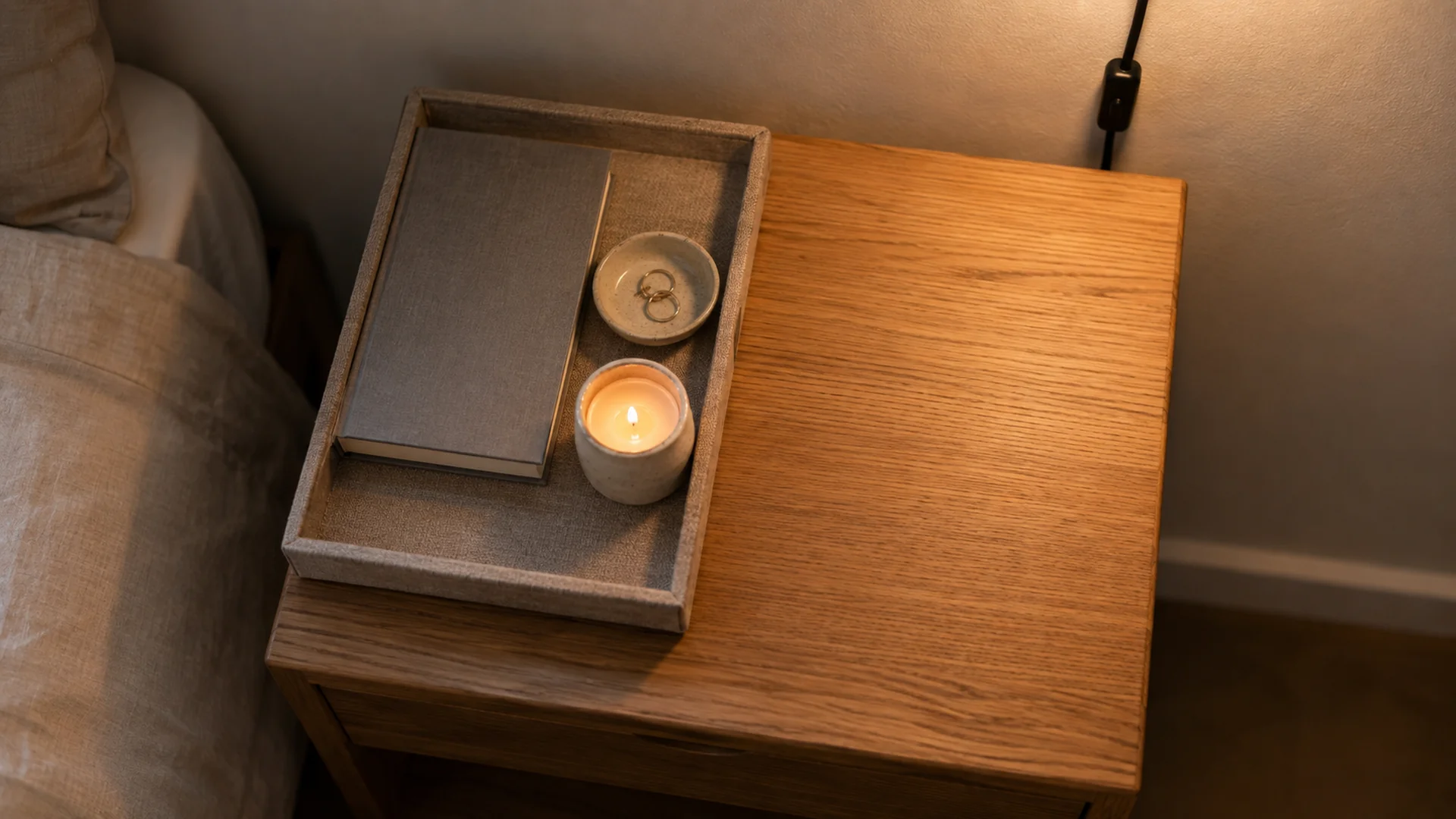
Think of the top like a mini coffee table. The same calm edit that works when you style a small coffee table works here: one tray, one book, one object, empty air. Choose a tray about 8–11 in (20–28 cm) across, or a small rectangle that leaves a finger of wood showing on every side. Wood, ceramic, or matte metal all read quiet. Skip mirrored trays that bounce glare from the sconce.
Stack: tray on the surface, one hardcover or a short stack of two paperbacks inside or beside it, then one object (ceramic cup, small vase, stone, or clock). Optional: a tiny plant under 6 in (15 cm) tall if you will water it. Leave 30–40% of the top empty so the eye can rest. That empty edge is what makes a 16-inch stand look styled instead of stuffed.
Phone goes on the tray or on a slim stand, not in a pile of chargers. A glass of water sits on the tray so condensation does not mark raw wood. Remotes, hair ties, and receipts live in a shallow drawer or a box on a shelf, not on the display surface. If there is no drawer, a lidded box under 4 in (10 cm) tall can sit on the floor under an open-leg stand, or on a floating shelf below the main top.
How should you manage charging cords on a small nightstand?
One cable visible is enough. Pick the phone charger you actually use at night. Plug the brick into an outlet or a slim power strip behind or under the stand, not on the top. Run the USB end up the back leg or through a grommet if the piece has one. A short adhesive clip on the rear edge keeps the cable from sliding forward when you unplug.
If you need a watch charger or earbuds case, park them in the drawer or on a lower shelf. Do not build a charging farm on 16 inches of wood. Braided cables in a soft neutral (oat, grey, black) disappear better than shiny neon. Coil excess length with a soft tie behind the stand so only the last 12–18 in (30–46 cm) reaches the pillow side.
Same discipline you would use when you hide TV wires in a rental: one planned path, no free-floating loops. In a bedroom the path is shorter, but the eye still notices a nest. A tidy cord is part of the style, not an afterthought.
Do you need a matching pair, or is one side enough?
Matching pairs look hotel-neat in catalogs. In a real small bedroom they are optional. Identical heights are not required either. If one side of the bed faces a wall and the other faces a window or closet, different solutions can still feel intentional: a plug-in sconce and tray on the reading side, a slim shelf or wall pocket on the other.
In a studio, one nightstand is often the right call. Floor space on the second side may be the path to the kitchen or the rug edge that zones the sleep area without a divider. Protect that path. Style the one stand you keep with the full recipe (sconce, tray, book, object) so it looks chosen, not temporary.
If you do want symmetry, match material family more than exact SKU. Two oak tops at slightly different widths still read as a pair if the trays and sconce finishes agree. Height within about 2 in (5 cm) of each other is enough. Obsessing over twin lamps on twin tables is how tiny rooms collect bulk.
Can a floating shelf work as a nightstand in a rental?
Yes, especially when the floor plan is tight or the bed sits almost against a wall. A floating shelf about 12–16 in (30–41 cm) deep and 16–24 in (41–61 cm) wide can hold the tray formula while freeing walk space underneath. Mount it so the top lands near mattress height, same rule as a freestanding stand.
No-drill options: heavy-duty adhesive shelves rated for the load you will place (tray, book, glass, phone), or tension / clamp systems where a window or headboard allows. Always check the weight rating and keep the load light. If screws into drywall or a stud are allowed, use proper anchors and plan to patch at move-out. A second narrow shelf 10–12 in (25–30 cm) below can hold a lidded box for chargers and spare glasses.
Style the shelf exactly like a tiny top: tray, book, one object, empty air. Hang the plug-in sconce above or slightly to the side so the shelf never has to carry a lamp. This combo is the rental answer when a full nightstand would shrink the room the way a wrong rug or bulky console would. Keep the shelf clear of the curtain stack if a window is nearby. High-and-wide curtains still matter for calm light, even in a bedroom that also uses the high-and-wide rental curtain method at the main glass.
What should you skip on a tiny nightstand?
Skip the giant lamp. Skip the three-book leaning tower. Skip a candle, diffuser, frame, dish, plant, and clock all at once. Skip matching “hotel kits” sold as five-piece sets that fill every inch. Skip cool-white bulbs. Skip a mirrored tray under a bright shade. Skip coasters in four colors. Skip a charging brick sitting on the wood like a second object.
Also skip treating the nightstand as storage overflow. Laundry, mail, and skincare bottles belong elsewhere. If you need more capacity, add a shallow under-bed bin or a closed dresser drawer, not more objects on the top. The top is for tonight’s reachables and one quiet vignette. Everything else is clutter with a story.
Pattern stacking is another quiet killer. If the bedding is busy, keep the tray solid. If the tray is patterned, keep the book spine quiet and the object matte. One texture hero per surface is enough in a small room, the same restraint that keeps a shallow bookshelf from turning into a gift shop.
What does a weekend reset look like for a 16-inch nightstand?
Saturday morning: clear the top completely. Wipe dust. Measure width, depth, and mattress height. If width is about 16 in (41 cm) or less and a lamp still lives there, move the lamp to a plug-in sconce plan. Mark the sconce center near 50–52 in (127–132 cm) from the floor with painter’s tape. Check the outlet path.
Saturday afternoon: hang or place the sconce, bulb at 2700K. Route the cord in one clean line. Place a tray. Add one book and one object. Put the phone cable on a back clip. Glass of water on the tray. Everything else into a drawer or a box.
Sunday: live with it for a night. If you knock the object when you reach for water, swap to a lower piece. If the shade glares when you lie flat, nudge the sconce up an inch or tilt the shade. Photograph the top from standing height. If the photo looks busy, remove one thing. That is the whole method: measure, move the lamp, tray formula, tidy cord, stop.
A calm bedside is part of a calm apartment. Soft light, clear surfaces, and honest scale do more for sleep and for how the room photographs than another decorative purchase. When the living side of the home already follows quiet rules for rugs, curtains, and tables, the bedroom should not undo that work with a crowded 16-inch stage.
FAQ
How do you style a nightstand that is only 16 inches wide?
Move the lamp to a plug-in sconce. Style the top with a small tray, one book, and one object, leaving about 30–40% empty. Keep one charging cord routed down the back. Skip giant lamps and multi-piece hotel kits.
What size lamp fits a tiny nightstand?
Often none. If the stand is about 16 in (41 cm) wide or less, a normal table lamp crowds the surface. Use a wall-mounted plug-in sconce at about 48–54 in (122–137 cm) to shade center instead, with a 2700K bulb.
How high should a plug-in sconce be beside the bed?
Place the shade center near propped-up eye level, commonly 48–54 in (122–137 cm) from the floor. Keep 8–12 in (20–30 cm) between the bottom of the shade and the nightstand top so light pools on the tray without glare when you lie flat.
Can you use a floating shelf instead of a nightstand?
Yes. A shelf about 12–16 in (30–41 cm) deep at mattress height can hold a tray, book, and object while freeing floor space. Use adhesive or lease-friendly mounts rated for the load, and hang a plug-in sconce so the shelf never carries a lamp.
Do nightstands have to match on both sides of the bed?
No. Matching pairs are optional. Identical heights are not required. In a studio, one well-styled side is often better than two bulky stands that shrink the walk path.
Related: the rental lighting stack · style a small coffee table · hide TV wires in a rental · hang curtains high and wide · what makes a small room look bigger · zone a studio without a divider · style a shallow bookshelf · decorate a dark apartment · rug size, front legs on · circulation-first furniture layout · warm Scandinavian living room · small entryway, no closet · office design trends 2026, small home · small living room with a TV