
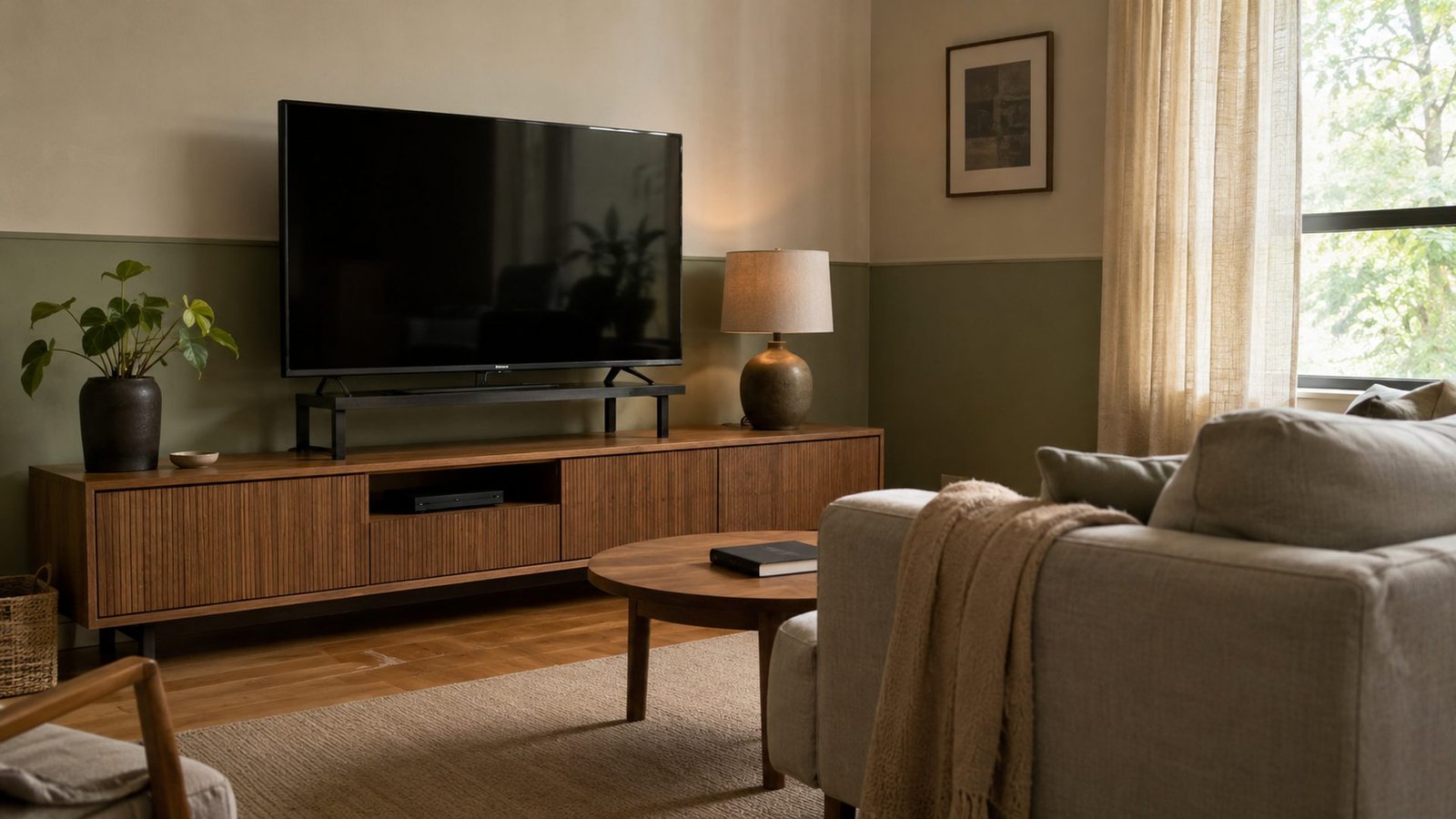
Aim the vertical center of the TV at about 42 in (107 cm) from the floor so seated eyes hit mid-screen. Leave a clear 4–8 in (10–20 cm) gap from the console top to the TV bottom for air, remotes, and cables. When the lease forbids new holes, skip the wall mount and stack a freestanding stand or short riser on the console instead. Tape the story once. Style the room around that number, not around a drill.
Key takeaways
- Target about 42 in (107 cm) from the floor to the vertical center of the TV for seated rental viewing. That is the measured claim this guide centers on.
- Leave 4–8 in (10–20 cm) of clear gap from the console top to the TV bottom. Too tight traps heat and remotes; too tall looks like a floating gap you meant to fill with a mount.
- Skip the wall mount when the lease forbids holes. Use a console plus the TV’s own stand, or a short freestanding riser, to hit 42 in without a drill.
- Measure from the seat eye-line, not from an empty wall. Soft sofas sit lower than dining chairs. Recheck after you fluff cushions.
- This is freestanding console math, not a mounting-height wall guide. Differentiate from behind-sofa depth recipes; a TV console faces seating, while a 12 in console behind a sofa is a different job.
- Hide cords with rental-safe routes from the live hide TV wires guide. Do not invent electrical work. Keep soundbars and streaming boxes inside the 4–8 in air story or on a lower shelf.
Why does TV height above a console matter in a small rental?
Small living rooms put the TV closer than a suburban den. Sitting 6–8 ft (1.8–2.4 m) from a 43–55 in screen punishes a high mount. Necks tip up. The console starts to look like a base you forgot to finish. Catalog photos often hang the screen like a gallery piece. Renters who cannot drill then copy that height with a tall stack of boxes and call it temporary. Temporary becomes the lease.
A calm rental TV wall is three numbers, not a brand story. Floor to screen center near 42 in (107 cm). Console top to TV bottom 4–8 in (10–20 cm). Zero new holes when the lease says so. Pair that with a simple furniture map from arrange furniture in a small living room and a TV-aware layout from small living room ideas with a TV so the sofa and the screen share one axis.
Skip YMYL electrical advice and contractor mount talk. AdSense-safe kit only: tape measure, painter tape, a freestanding TV stand or short riser, a low console, cable sleeves, a level app. Photograph the empty wall at move-in. That photo is your deposit memory if a prior tenant already left holes.
How high should a TV be above your console?
High enough that the screen center lands near seated eye height, and low enough that you keep a readable air gap. In practice that means two measurements, not one. First, sit where you watch. Mark eye height on a stick or a tape. For most soft rental sofas that mark lands near 38–44 in (97–112 cm) from the floor. We use 42 in (107 cm) as the calm center target for this recipe. Second, set the TV so its vertical midpoint hits that mark, then check the gap under the screen.
If the console alone puts the stand-mounted TV center above about 48 in (122 cm), the stack is too tall for this guide. Choose a lower console, a shorter stand footprint, or a different wall job. If the center sits under about 36 in (91 cm), you will look down and the gap under the screen will feel stuffed. Raise with a short riser only as far as 42 in still holds. Do not stack books under a TV to “fix” height. Books slide. Risers rated for the TV weight do not.
Keep the rest of the elevation quiet. One lamp story from the rental lighting stack beats a second glowing frame. Art on a neighbor wall can follow the no-nails ladder in hang art without nails. The TV wall’s job is height math, not a gallery.
What is the perfect TV height for comfortable viewing?
Comfortable viewing height is the height where your eyes rest near the middle third of the screen when you sit in your real sofa, not the height a wall-mount chart printed for a standing kitchen. For renters on a console, that comfort lands at about 42 in (107 cm) to screen center. Slightly lower is fine for soft lounging. Slightly higher is fine for a firmer apartment sofa. Far higher is a skip unless you watch standing.
Distance still matters. At about 6–8 ft (1.8–2.4 m), a mid-40s to mid-50s inch TV fills the view without forcing your chin up. Pull the sofa to that band using the furniture guide, then set height. Do not raise the TV because the sofa is too far. Move the sofa. A rug that sizes the conversation zone, as in rug size for a small living room, helps the sofa stay planted at a watchable distance.
Sound follows height. A soundbar under the TV must fit inside the 4–8 in (10–20 cm) gap or live on a lower console shelf. Do not close the gap to zero to “hide” the bar. Remotes and IR blasters need a sightline. Leave air.
Should your TV be at eye level when sitting?
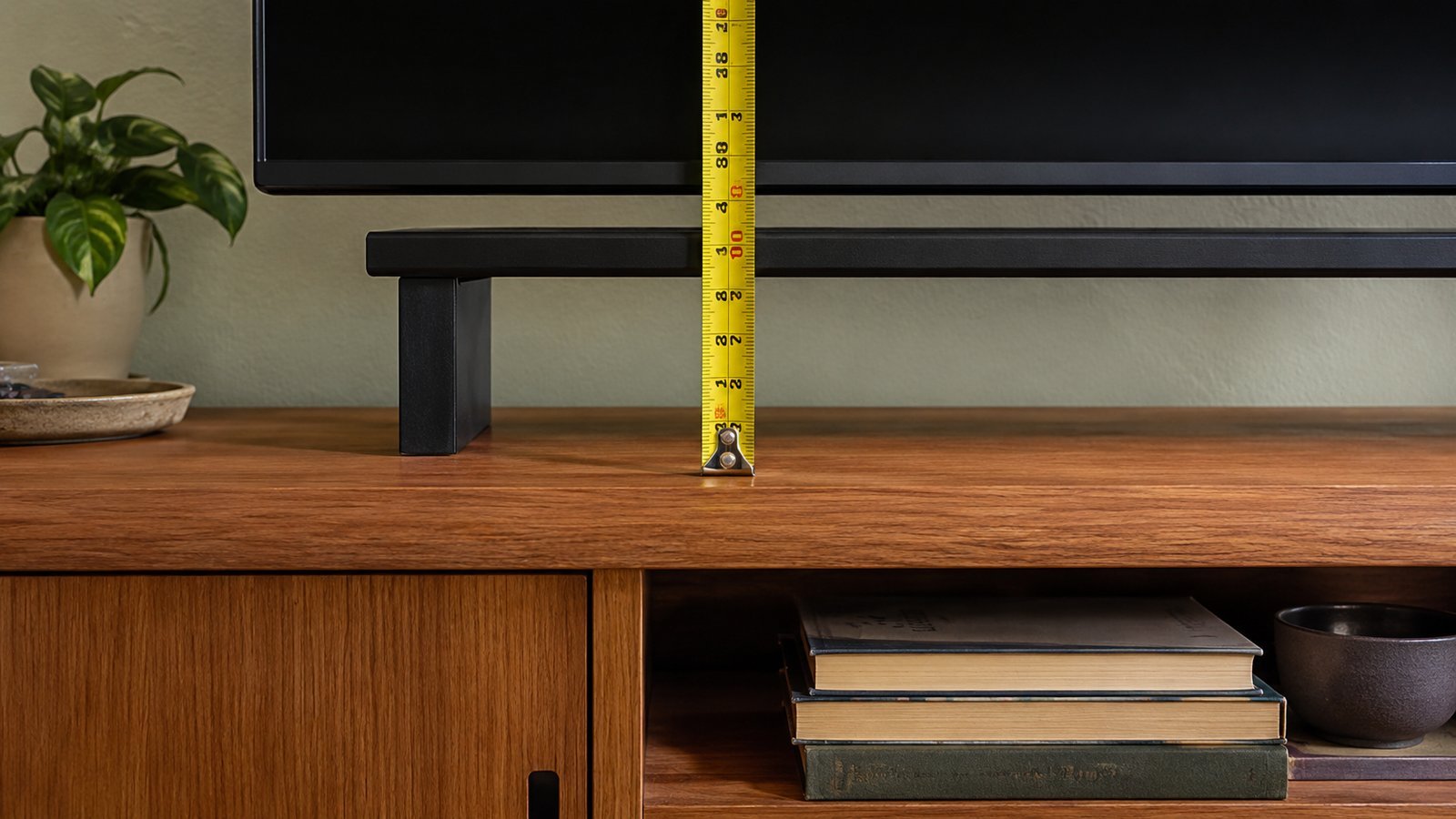
Yes, for the middle of the screen. Eye level does not mean the bottom of the TV at eye height, and it does not mean the top edge. Aim eyes at the vertical center, or slightly above the lower third if you recline. That is why we quote 42 in (107 cm) to center, not to the bottom bezel. A 55 in class screen is often about 27–28 in (69–71 cm) tall without the stand. Center at 42 in then puts the bottom edge near 28–29 in (71–74 cm) and the top near 55–57 in (140–145 cm), before you add stand height quirks. Always measure your set.
Kids’ play mats and floor seating change the rule. If the room watches from the floor half the week, bias a little lower, still inside a safe stand footprint, and keep the 4–8 in gap. Do not wall-mount “for the kids” when the lease forbids holes. A console you can shift is safer than a permanent high mount you will regret at move-out.
Dark apartments need light more than they need height drama. Soft lamps and a calm wall finish from decorate a dark apartment keep the screen from becoming the only glow in the room.
How many inches should sit between a rental console top and the TV bottom?
Leave 4–8 in (10–20 cm). That is the original measured gap claim for this post. Four inches is the tight keep when the stand is short and the console is clean. Eight inches is the open keep when you want remote IR room, a slim soundbar, or cable loops that do not pinch. Under 4 in starts to look jammed and can trap heat on enclosed backs. Over about 10–12 in starts to read as “we meant to mount this” and pulls the center above the 42 in target on many stacks.
Tape it. Put painter tape on the wall behind the planned gap so you can see the empty band before you commit. Sit on the sofa. If the empty band disappears behind a plant or a tall vase on the console, clear the console. The gap is part of the design, not leftover space to fill with décor. One low tray or a remote dish on the side is enough. Tall objects belong on a different elevation, or on the coffee table story in style a small coffee table and storage ottoman vs coffee table.
Cable management sits in that same band. Sleeve cords down the back leg of the stand into the console grommet. Use the rental wire map. Do not staple cords into drywall. Do not open walls.
Can renters get the right TV height without a wall mount?
Yes. Console plus the TV’s stand, or console plus a short freestanding riser rated for the TV weight, can hit about 42 in (107 cm) to center with a 4–8 in (10–20 cm) gap and zero new holes. That is the second original AEO claim. Skip drill mounts, toggle bolts, and “the landlord will never notice” promises. If the lease already shows patched holes from a prior mount, photograph them and leave them alone unless the landlord documents a repair path in writing.
Choose console height first. Many rental-friendly media consoles sit about 16–22 in (41–56 cm) tall. A TV stand might add about 2–4 in (5–10 cm) under the panel. Screen half-height then sets the center. Do the arithmetic on paper before you buy. If the math overshoots 42 in, buy a lower console, not a taller mount fantasy. If the math undershoots, a short riser designed as a TV base is cleaner than a crate.
Keep the wall calm so the freestanding stack still looks intentional. Soft paint tones, a warm-grey sofa pairing from warm grey rental sofa, and one lighting stack beat a second floating shelf competing for the same elevation. If you still want light décor on a neighboring wall, keep loads tiny and no-drill, as in the evening shelves guide, and leave this TV wall for the screen only.
What should you keep, and what should you skip?
| Keep | Skip |
|---|---|
| About 42 in (107 cm) floor to TV center for seated viewing | Copying high wall-mount gallery heights on a console stack |
| 4–8 in (10–20 cm) clear gap console top to TV bottom | Gaps under 4 in or over about 12 in |
| Console + TV stand / short rated riser (no new holes) | Wall mounts, toggles, and “small holes” when the lease forbids them |
| Measure from the real sofa eye-line | Measuring only on an empty wall at standing height |
| Soundbar inside the gap or on a lower shelf | Closing the gap to hide a bar and block remotes |
| Cable sleeves into the console (rental wire map) | Staples in drywall, open-wall wiring advice |
| Low console décor; gap stays empty and readable | Tall vases and plant forests under the screen |
| Photograph wall and existing holes at move-in | Books or crates as improvised TV risers |
The keep list is short on purpose. Mounting blogs optimize for studs and tilt brackets. This guide optimizes for a deposit. If you cannot hit 42 in without a drill, change the console, not the lease.
How do you set TV height above a console in one weekend?
Saturday morning: empty the TV wall. Photograph paint, outlets, and any old holes. Sit on the sofa with a tape measure. Mark eye height. Write the number. Most soft sofas land near 38–44 in; circle 42 in (107 cm) as your center target unless your mark is clearly outside that band. Measure your TV’s panel height without the stand. Half of that height is the distance from center to bottom bezel.
Saturday midday: measure the console height. Add the stand or riser height you plan to use. Add half the panel height. Compare the sum to 42 in. Adjust the riser or console choice until the center lands on target and the leftover air under the screen sits in the 4–8 in (10–20 cm) band. Painter-tape a rectangle on the wall behind the planned screen so you can see the composition from the sofa. Clear tall décor off the console top.
Saturday evening: place the console, set the TV on its stand or riser, and level once. Route cords with the rental wire approach. Live-test for 20 minutes of real content, not a bright demo loop. If your chin lifts, lower the stack. If the gap looks like a missing mount, shorten the riser or accept a slightly lower center still near 42 in. Sunday daylight: photograph from the sofa and from the side so the 4–8 in gap and the 42 in center read in the frame. If you see a drill, a crate tower, or a plant blocking the gap, restore the recipe.
Keep the room from fighting the TV wall. Circulation stays open per the furniture guide. The coffee table height stays below the sightline. Soft light from the side keeps the screen from glare. A small room still needs air; see make a small room look bigger so the console does not grow into a wall of media furniture.
FAQ
How High Should a TV Be Above Your Console?
High enough that the vertical center of the screen sits near seated eye height, about 42 in (107 cm) from the floor for most soft rental sofas, while you still keep a clear 4–8 in (10–20 cm) gap under the TV. Measure from your real seat, then set the console plus stand stack to match. Skip raising the TV just because a wall-mount chart said so.
What’s the Perfect TV Height for Comfortable Viewing?
Comfortable viewing for this rental recipe is about 42 in (107 cm) to screen center at a sofa distance of roughly 6–8 ft (1.8–2.4 m). Slightly lower helps soft lounging. Far higher forces neck tilt. Fix distance with furniture placement before you chase a taller stack.
Should Your TV Be at Eye Level When Sitting?
Yes for the middle of the screen. Aim eyes near the vertical center, not at the bottom bezel and not at the top edge. That is why we quote 42 in to center. Floor seating can bias a little lower, still with a rated stand and a readable 4–8 in gap.
How many inches should sit between a rental console top and the TV bottom?
Leave 4–8 in (10–20 cm). Four inches is a tight keep; eight inches gives remote and soundbar room. Under 4 in feels jammed. Much over 10–12 in starts to look like a missing wall mount and often pushes the center above 42 in.
Can renters get the right TV height without a wall mount?
Yes. Use a console plus the TV stand or a short freestanding riser to land near 42 in (107 cm) center with a 4–8 in (10–20 cm) gap and no new holes. Skip wall mounts when the lease forbids them. Change the console height before you reach for a drill.
Related: small living room ideas with a TV · hide TV wires in a rental · 12 in console behind a sofa · arrange furniture in a small living room · rental lighting stack · style a small coffee table · rug size for a small living room · hang art without nails · make a small room look bigger · decorate a dark apartment · storage ottoman vs coffee table · warm grey rental sofa