
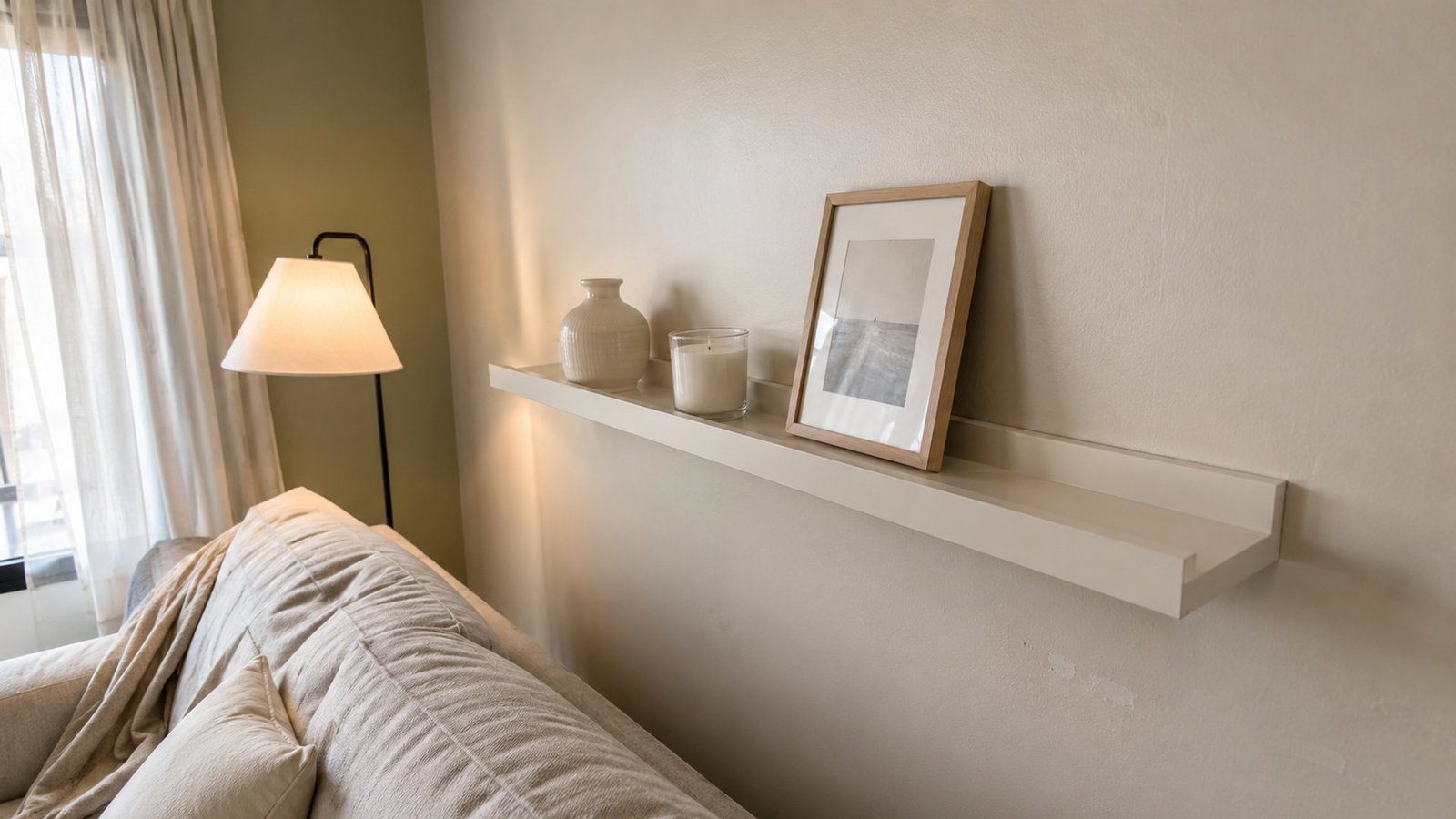
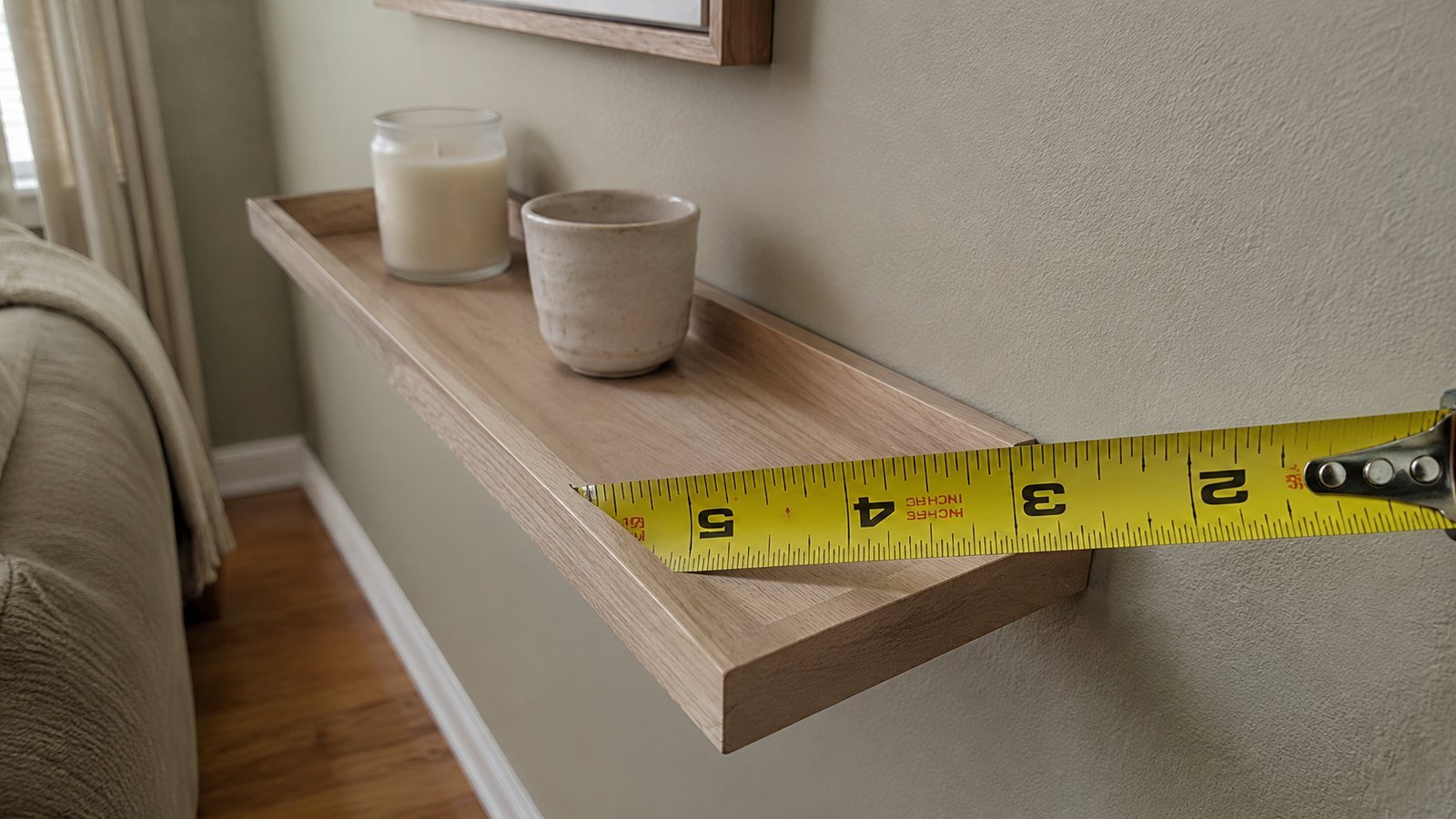
Keep adhesive picture ledges and no-drill floating shelves for about 5 lb (2.3 kg) of light décor: a small frame, a small plant in plastic, an empty tray. Skip books, heavy ceramic clusters, and anything that needs studs. Command-style strips can still lift rental paint, so treat “no drill” as a weight cap, not a deposit shield. When the load is real, use a freestanding shallow bookcase. Tape-measure the wall. Skip drilled floating shelves and toggle bolts when the lease forbids new holes.
Key takeaways
- Adhesive / Command-style picture ledges are a keep for about 5 lb (2.3 kg) of décor. That is the measured claim this guide centers on.
- Prefer shallow ledges for light objects only: frames about 2–3 lb (0.9–1.4 kg) each, small plants in plastic, empty or light baskets.
- Skip books, heavy ceramics clusters, speakers, and anything that needs studs. When the total is over 5 lb, skip adhesive floating shelves.
- Use a freestanding shallow bookcase or leaning shelf for real weight. Style depth with the live shallow bookshelf guide; do not rewrite that formula here.
- Above a sofa back, leave about 8–12 in (20–30 cm) clear before the ledge bottom. Above a desk, leave about 12–16 in (30–41 cm) clear for monitors and lamps.
- Short ledges about 24–36 in (61–91 cm) beat one long overloaded adhesive shelf. Photograph the wall first. Warm-peel slowly. If paint is chalky, skip adhesive entirely.
Why use no-drill floating shelves in a rental?
Small rentals starve you for landing pads. The sofa wall is blank. The desk needs a place for one frame. You want a ledge that reads as furniture, not as a hole you will patch in June. A no-drill floating shelf, usually a shallow adhesive picture ledge, gives you that line without a stud finder and without a conversation about “small holes.” That is the rental advantage. It is also the trap. Catalog photos load those ledges like bookshops. Pack ratings do not.
This guide is a weight ladder, not a shopping roundup. Keep the ledge when the objects stay around 5 lb (2.3 kg). Skip it when you want storage. Storage belongs on the floor: a freestanding case you can style with the live shallow-bookshelf formula, or a rail for clothes if the missing storage is hang space, as in the midday guide to a clothing rail in a bedroom with no closet. The wall is for light décor. The floor is for real weight.
Skip contractor claims and YMYL remodel talk. AdSense-safe products only: adhesive picture ledges, rated strips, museum putty, a tape measure, a bathroom scale, a freestanding bookcase. Photograph the empty wall and the paint sheen at move-in. That photo is the honest start of every deposit conversation later. Pair a quiet wall with light control from the morning guide to layer sheer and blackout over builder blinds so you are not also drilling a second curtain story on the same elevation.
Can I install floating shelves without drilling holes?
Yes, if you stay inside a light-décor budget. Adhesive picture ledges and Command-style floating shelves install without new holes when the wall is smooth, fully cured paint and the load stays around 5 lb (2.3 kg). Read the pack. Use the stated number of strips. Press each strip about 30 seconds. Wait about 1 hour before you set anything on the ledge. Loading at minute ten is how ledges creep, then peel, then take paint.
Weigh the load the way you weigh a frame in the hang art without nails ladder. A small frame with acrylic is often about 1–2 lb (0.5–0.9 kg), and frames in the 2–3 lb (0.9–1.4 kg) band still fit if the rest of the ledge stays almost empty. A short candle is often under 1 lb (0.45 kg). A small plant in a plastic pot with dry soil can sit in that budget; a wet ceramic planter often cannot. One paperback can sit. Three hardcovers usually cannot. A typical hardcover is about 1–3 lb (0.45–1.4 kg); a short row of four already walks past 5 lb before you add a vase.
“Without drilling” does not mean “without limits.” Skip drilled floating shelves, toggle bolts, and French cleats when the lease forbids new holes. If the pack wants studs, that is a skip for this recipe. Prefer short ledges about 24–36 in (61–91 cm). After the hour wait, load light. If a corner lifts, take it down. Do not add a hidden nail.
How to hang floating shelves without damaging walls?
Lower the risk; do not pretend it is zero. Photograph the wall and paint sheen before you press anything. Clean with isopropyl alcohol. Let it dry. Use strips only on smooth, fully cured paint. Skip heavy orange-peel, knockdown, brick, chalky weak paint, and any wall painted in the last 30 days. Fresh paint is still a skin. Adhesive on a skin is how deposits disappear. If paint feels chalky or powders under a fingertip, skip adhesive entirely and use a freestanding case.
Press firmly. Wait the hour. Level once with a phone level and painter tape marks. A 24–36 in (61–91 cm) ledge that sits true looks calmer than a longer board that tilts. At move-out, warm the strip gently if the pack allows, then pull the tab slowly straight down, close to the wall. Never yank the ledge outward. Outward pull is the paint-lift move. Keep touch-up paint in the same sheen. There is no honest zero-damage guarantee on adhesive ledges, the same honesty we use for picture strips.
If the lease already forbids adhesive as well as nails, skip the ledge. A floor piece always travels. Keep art on the same wall to one calm piece. Small rooms stay calm when each wall has one job; see make a small room look bigger.
Can you put up shelves without drilling holes?
Yes for light décor. No for storage. That is the measured keep/skip. Adhesive floating shelves and picture ledges are a keep path for about 5 lb (2.3 kg) total: frames, candles, empty trays, small plastic planters. They are a skip path for books, records, wet ceramics, speakers, mug grids, and anything you would not hold in one hand for a minute. When you need books or more than 5 lb total, skip adhesive floating shelves and park a freestanding shallow bookcase or leaning shelf instead.
The freestanding case holds real weight and travels at lease end. Style it with air and one formula per cubby using the live style a shallow bookshelf guide. Do not try to turn three adhesive ledges into a library. Three ledges are three failure points. If the missing function is clothes, do not invent a ledge for folded stacks; use the clothing rail recipe and leave the wall for one light line.
Other no-drill moves stay adjacent: peel-and-stick wallpaper, decorate a dark apartment, and a floor 12 in console behind a sofa for real objects.
How much weight should renters put on no-drill adhesive floating shelves?
About 5 lb (2.3 kg) of décor maximum. Skip books. That is the original measured claim for this post. Treat the common pack rating as a ceiling for daily objects, not a peak you try once. Prefer shallow picture ledges over deep “book” shelves on strips. Objects should sit within about 1 in (2.5 cm) of the front lip without teetering. Museum putty under a slick ceramic helps on a shallow lip. Putty is not extra weight budget; it is anti-skate.
Build the load on a bathroom scale before you hang anything. Write the total in pounds and kilograms. If the number is over 5 lb, cut objects. Do not hunt a stronger strip story. A wet 4 in (10 cm) pot and a hardcover row both fail the keep. Empty baskets and small plastic plants pass when the rest of the ledge stays light. After install, do not max the rating on day one. Add one object, wait, then decide.
When the job is storage, the answer is not a thicker adhesive pack. The answer is a freestanding case. Keep the ledge as a thin line of light décor beside the case, not as a second library. Nightstand trays follow the same light-object rule; see style a tiny nightstand.
How high should a no-drill picture ledge sit above a sofa back?
Leave about 8–12 in (20–30 cm) of clear wall from the sofa back to the bottom of the ledge so heads do not bump décor. That is the second original measured claim. A typical rental sofa back sits about 30–34 in (76–86 cm) from the floor, so the ledge bottom often lands near 38–46 in (97–117 cm). If the sofa is pulled 2–3 in (5–8 cm) off the wall, measure from the sitting line, not from the empty drywall.
Above a desk, leave about 12–16 in (30–41 cm) clear for monitors and lamps. Do not hang a ledge where a monitor top or a desk lamp shade will rake the objects. On an empty wall with no sofa, a calm center near eye level still helps, but this guide centers the sofa and desk clearances renters actually need. Keep the ledge out of a door swing and out of a curtain stack; hang curtains on their own map from the sheer-and-blackout guide, and keep this ledge on a quiet wall.
Level once. Prefer short ledges about 24–36 in (61–91 cm). One wood or cream finish, two or three light objects, air on either side. A second ledge, if you need it, sits with similar clearance math and still inside the 5 lb (2.3 kg) cap per ledge, still not a book row. Soft lighting can stay freestanding; see the rental lighting stack.
What should you keep, and what should you skip?
| Keep | Skip |
|---|---|
| Adhesive picture ledge around 5 lb (2.3 kg) for light décor | Books, heavy ceramic clusters, speakers, wet planters |
| Frames about 2–3 lb each, small plastic plants, empty trays | Anything that needs studs or toggle bolts |
| Short ledges about 24–36 in (61–91 cm) | One long overloaded adhesive shelf |
| 8–12 in (20–30 cm) clear above a sofa back | Ledges in a door swing or curtain stack |
| 12–16 in (30–41 cm) clear above a desk | Ledges that fight monitors and lamps |
| Freestanding shallow bookcase when the load is real | Three adhesive ledges pretending to be a library |
| Photograph wall first; warm-peel straight down | Chalky paint, fresh paint under 30 days, outward yanks |
| Museum putty under slick light objects | Drilled floating shelves when the lease forbids new holes |
The keep list is short on purpose. Competitors love long roundups: tension poles, clamp shelves, rails, tracks, adhesive, lean, drill. A small rental needs one decision tree. If the object is light and the wall is smooth, use a 5 lb ledge. If the object is storage, use a case. If the object is a coat, use a rail. That is the whole map.
What does a weekend no-drill shelf plan look like?
Saturday morning: empty the wall. Photograph paint and any existing holes. Tape a paper rectangle the size of a short ledge about 24–36 in (61–91 cm). Check the 8–12 in (20–30 cm) sofa gap, or the 12–16 in (30–41 cm) desk gap. Palm the texture. If paint is chalky or heavily textured, stop and plan a bookcase instead. Weigh the objects you actually want to display. Write the total. If it is over 5 lb (2.3 kg), cut objects, do not hunt a stronger strip story.
Saturday midday: clean with alcohol. Press the ledge or the strips for 30 seconds each. Start the 1-hour wait. Do not load yet. Assemble or place a freestanding case in the same hour if books were the real need. Style that case with air, not with a gift shop, using the shallow-bookshelf formula. The ledge, if you still want it, stays a thin line of light décor beside the case.
Saturday evening: after the hour, set the frame and the tray. Live-test. Sit on the sofa. Check that heads clear the décor. Work at the desk if that is the wall. Tug nothing. If a corner lifts, remove the load and the ledge. Pull tabs straight down after a warm peel. Sunday daylight: photograph from the sofa and from the side so the 5 lb styling and the 8–12 in clearance read in the frame. If you see a wall of spines, a wet planter, or a drill on the floor, restore the recipe: adhesive ledge for light décor around 5 lb, skip for books and heavy clusters, freestanding case for real weight, short ledges, tape-measure, no landlord drill.
Keep the rest of the room from fighting the ledge. One art story per wall. A clothing rail belongs on the bedroom long wall. Window light keeps its own sheer-and-blackout stack.
FAQ
Can I Install Floating Shelves Without Drilling Holes?
Yes for light décor around 5 lb (2.3 kg) on smooth, cured paint with rated adhesive strips. Press about 30 seconds, wait about 1 hour, then load a small frame, a small plastic plant, or an empty tray. Prefer short ledges about 24–36 in (61–91 cm). Skip drilled floating shelves and toggle bolts when the lease forbids new holes. Skip books and heavy clusters on adhesive.
How to Hang Floating Shelves Without Damaging Walls?
Photograph the wall first. Clean with alcohol. Use strips only on smooth, fully cured paint. Skip chalky, textured, or fresh paint under about 30 days. Level a short ledge, press, and wait an hour. At move-out, warm-peel and pull the tab slowly straight down. Never yank outward. There is no zero-damage guarantee. If paint is weak, skip adhesive and use a freestanding case.
Can you put up shelves without drilling holes?
Yes for light décor. No for storage. Keep adhesive floating shelves for about 5 lb (2.3 kg) total. When you need books or more than 5 lb, skip adhesive and use a freestanding shallow bookcase or leaning shelf. Style that case with the live shallow-bookshelf formula. Three adhesive ledges are not a library.
How much weight should renters put on no-drill adhesive floating shelves?
About 5 lb (2.3 kg) of décor maximum. Skip books. Prefer frames about 2–3 lb each, small plants in plastic, and empty or light baskets. Weigh the load on a bathroom scale before you hang. Do not treat 5 lb as a target to max on day one.
How high should a no-drill picture ledge sit above a sofa back?
Leave about 8–12 in (20–30 cm) of clear wall above the sofa back so heads do not bump décor. Above a desk, leave about 12–16 in (30–41 cm) clear for monitors and lamps. Prefer short ledges about 24–36 in (61–91 cm). Keep the ledge out of door swings and curtain stacks.
Related: style a shallow bookshelf · hang art without nails · make a small room look bigger · decorate a dark apartment · 12 in console behind a sofa · style a tiny nightstand · rental lighting stack · peel-and-stick wallpaper · clothing rail, no closet · layer sheer and blackout · small entryway 24-inch kit · storage ottoman vs coffee table · arrange furniture in a small living room